Writers of Equestrian Fiction
Ride with us into a world of suspense, romance, comedy, and mystery --
Because life always looks better from the back of a horse!
Tuesday, November 12, 2013
I Answer a Few Critics
Sunday, June 23, 2013
My Life With Horses--Part Nine
Wednesday, June 19, 2013
My Life With Horses--Part Eight
Wednesday, December 19, 2012
Bad News and Good News
Wednesday, April 13, 2011
The Real Horses Behind My Fiction
By Laura Crum
I usually write posts about what I’m currently doing with my horses—but at the moment, just as Alison said in her last post, there’s not much for me to say. The occasional quick ride and turning them out to graze is about it. Instead I’m focusing very hard on finishing my twelfth mystery novel, which I must turn in to the editor at the end of the month. So my attention is really on my writing. But that doesn’t mean I’m not thinking about my horses. Because my horses play a big part in my books.
In my novel, Chasing Cans, for instance, Gail McCarthy, my equine veterinarian protagonist, acquires a pony for her child. This particular plot device never would have occurred to me were it not for the fact that several years ago I acquired a pony for my little boy. I had never owned a pony before and Toby was an education to me. I found the little critter so endearing that I just had to write about him, and Toby our pony is faithfully described in Chasing Cans, though the way in which Gail acquires him is rather different than the way in which I came by the real Toby.
This is often the case with my equine characters. Over the course of my twelve mystery novels, I’ve based virtually every horse that Gail encounters, owns or rides on real horses I’ve known. Gunner, who is Gail’s main mount through most of the books, is modeled on my own horse, Gunner. He is accurately portrayed as to appearance (a fifteen-three hand Quarter Horse gelding with white socks, a blaze and a blue eye), personality and quirks (the real Gunner is a big spook, as is Gail’s “Gunner”), but the living horse’s history is a bit different from the fictional one.
Gail acquires her horse Gunner when a veterinary client refuses to spend the money and time it would take to allow the horse a chance at recovering from severed flexor tendons. (This occurs in my first novel, Cutter.) Gail takes the horse to save him from euthanasia. (The story is also based on a real horse; it just wasn’t Gunner.)
The real Gunner’s life history is rather different. I acquired him as a three-year-old, just as Gail did her Gunner. I was twenty-four years old and working for a prominent reined cowhorse trainer who shall remain nameless. As his assistant, I rode a string of eight horses every day; these were horses that, for whatever reason, he didn’t care to ride. Some he considered less talented, some were in the barn just to be broke and the owners weren’t interested in showing them, some had a bad attitude (poor me)…etc. Gunner was in my string because the trainer wasn’t collecting training fees on him; the horse was there to be sold. Gunner was a well-bred and talented cowhorse prospect, and the trainer thought that not only would he collect a fat commission when he sold the horse, he might also be able to place him with one of his own clients who would then pay the trainer to ride this gelding and perhaps enter him in the major futurities. Needless to say the price tag on this horse was high. He was probably the best colt I had in my string; he was also a very likable horse.
Just as he is described in my books, Gunner had a friendly, clownish personality, a willing and cooperative nature, and tons of athletic ability. He came to me in January of his three-year-old year with about thirty rides on him, and I took it from there. He was always an easy horse, never prone to bucking or other negative behaviors, other than his penchant for unexpected sudden twenty foot sideways leaps whenever he saw something worth spooking at, which was often. He never dumped me (and never meant to), but it was a near thing more than once.
Despite the swerves, I loved riding Gunner. It amazed me how quickly this colt came on and how much “cow” he had. As the months passed with no buyer coming up with the purchase price, I grew fonder and fonder of this horse. I began hoping desperately that no one would buy him; I dreaded his removal from the barn or seeing him placed in the trainer’s string (by this time I’d had lots of experience with the well known trainer’s rather harsh methods and didn’t want to see this kind, willing colt subjected to them).
Eventually the day came. A prospective buyer was due to arrive, one who would surely buy Gunner. He was a rich man; the purchase price would mean nothing to him. He was known to be looking for a good futurity prospect and to like Gunner’s breeding. The trainer was very keen to make the deal. I gave Gunner a bath with tears running down my face. That morning, despite the fact that I had no idea where I would get the money, I told the trainer I would give him the full price for the horse and wrote and handed him a deposit check.
I’ve never regretted this decision. I borrowed the money to buy Gunner and I left that trainer’s employment almost immediately thereafter. I trained Gunner myself and showed him at a couple of futurities and “stakes” as a three and four year old, winning some very minor awards. Gunner became an accomplished cutting horse over the years and I won quite a few events with him eventually. Later I trained him to be a team roping horse and competed on him for several years at ropings. I still own Gunner; he’s thirty-one and sound, if a bit stiff, and retired to the pasture. He’s been my friend the whole time.
Gail’s Gunner is given a slightly different history. She never uses him as a cutting horse, but does compete on him at team roping in Roped, my fourth mystery novel. In Slickrock, the fifth book in the series, she rides him on a major pack trip through the Sierra Nevada Mts of California. Though this pack trip is based on many pack trips that I made over those same mountain passes, the mount that I used on those trips was Flanigan, a horse I also rode for years and loved dearly, just as I did Gunner. Flanigan loaned his skills as a team roping horse and his quirky personality to Burt in my third novel, Roughstock.
In my latest novel, Going, Gone, Gail acquires Sunny, who is my current riding horse. The fictional Sunny is an accurate portrayal of the real Sunny, and those of you who read my blog posts will instantly recognize this horse. So the horses in my books are real horses, and the adventures Gail has with them are all based on things I have really done with my own horses. Thus my mystery series is a tapestry of fact and fiction, which I hope will engage readers in much the same way that the actual horses have engaged me.
Anyway, since I am currently pushing so hard to complete one more book, I thought you all might like to see how I have worked my horses into the stories, and perhaps some of you who enjoy these blog posts will be moved to give my novels a try.
And for those who would like to buy my earlier novels in hardcover (they are out of print), my friend/boarder, Wally, sells them through his feedstore. Wally doesn’t do the internet, but if you call Valley Feed, 831-728-2244 (in California) and give Wally or Lynn a credit card number, you can order any of my first eight books for $20.00 each (which includes shipping to anywhere in the continental US), and you will get signed copies, which I will also personalize for you if you would like. If you want to find out more about these books and read the first chapters, you can go to my website www.lauracrum.com
Anyone who has read my novels please feel free to give a reader review in the comments. I like feedback and can stand a bit of criticism, so let me (and others) know what you liked or didn’t like. Cheers--Laura
Saturday, May 31, 2008
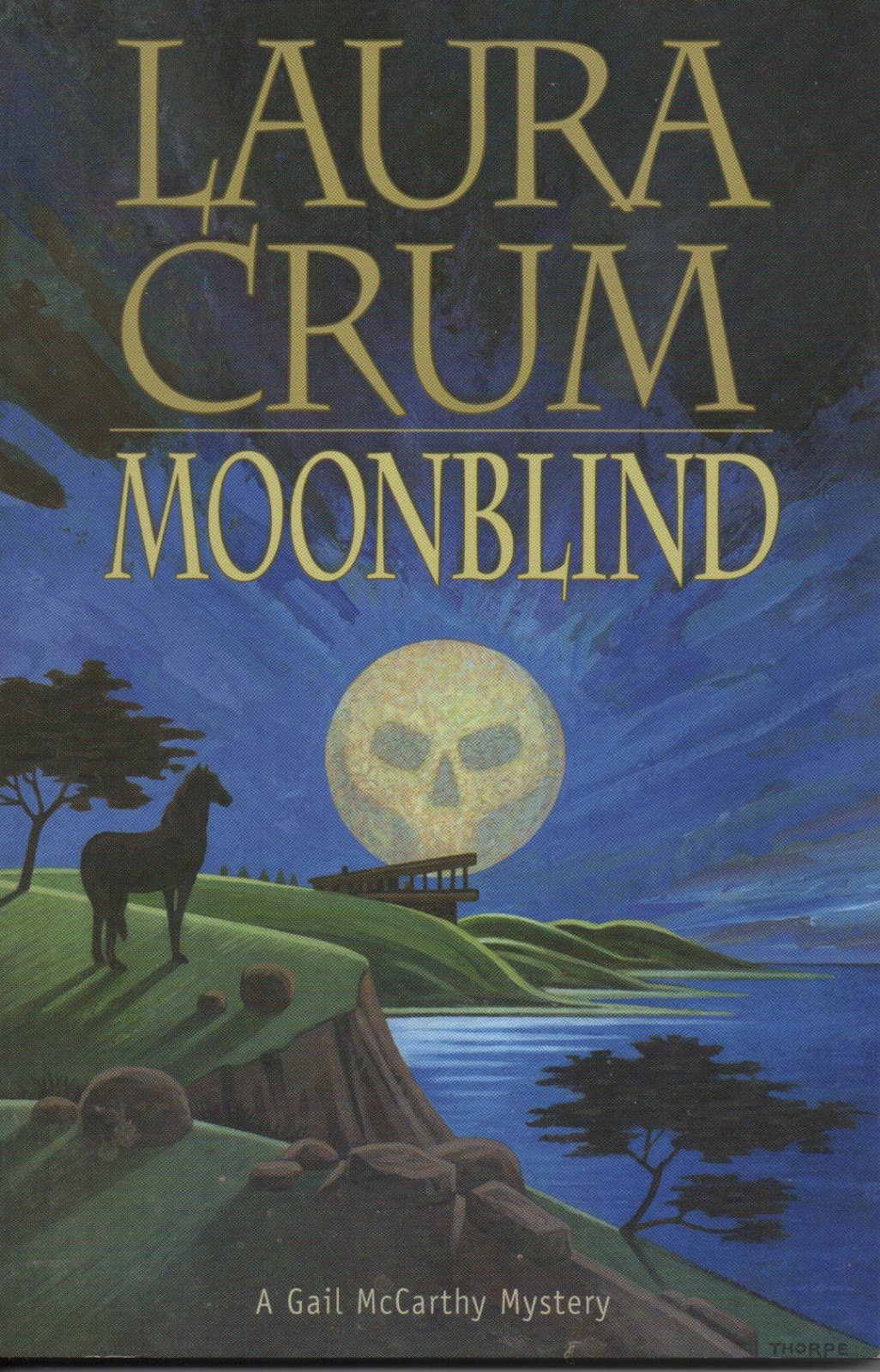
Why Ever Did You Pick That Cover?
As the author of ten mysteries featuring equine veterinarian Gail McCarthy, I’ve frequently been asked the above question. Believe me, on some of those books I would have asked the question myself, if I had been the reader. The truth is that I didn’t pick that cover(!) In fact, I had virtually nothing to say about it.
My first mystery, Cutter, came out in hardcover from St Martin’s Press in 1994. Needless to say, I waited with great excitement to see what the jacket would look like. (For those unfamiliar with this process, it takes roughly a year from the moment of turning a manuscript in to the publisher until the finished book arrives in the mail…a long wait.) I can still remember my immediate sense of deflation when I finally saw the book. It looks like Nancy Drew, were the words that came to mind.Still, I had no idea how dire things can get in the book cover department. Not until I saw the paperback version of Cutter. Not only did this cover also look very YA, the artist had depicted my western cutting horse with an English saddle (!) You can imagine the comments I got on that one. Unfortunately, most of the world believes that an author personally chooses or designs the cover—I hate to think how many folks may consider me dismally ignorant on the subject of cutting horses, based on this jacket.
Fortunately Hoofprints, my second novel, had a much more pleasing cover than Cutter. Or at least, I thought so. (Not coincidentally, at least in my opinion, it sold a lot better, too.) When I praised the cover to my agent, however, she sniffed dismissively. I was quite surprised that she didn’t seem to like the jacket. Novice in the publishing business that I was, I had paid no attention to the lettering. My agent was no novice. “I wish they’d done your name a little larger,” was all she said.
Finally, on my third mystery, Roughstock, I hit the jackpot. I loved the cover, and virtually everyone who saw the book did, too. Not to mention my name was nice and big. (Roughstock also sold very well, by the way.) The cover artist, Peter Thorpe, had emailed me in the course of his work (being one of that lovely breed who actually reads the material and tries to make the cover fit), so I was able to thank him for a great job. Naturally I requested him thereafter.
This system didn’t work all the time. The art director at a big house like St Martin’s has a tendency to be a “revolving door” position. Seldom did I have the same art director from book to book. So, periodically the current inhabitant of the office would decide to replace my favorite artist with someone else, usually not to good effect. For instance my sixth novel, Breakaway, which is one of my favorite books, but also probably the “darkest” of my mysteries and the least suitable for young readers, has a cover that looks more YA than all the rest. Needless to say, I was not thrilled.
Cheers,
Laura Crum

Tuesday, May 27, 2008
Toby the Pony

In my latest mystery novel, Chasing Cans, just out this spring, my protagonist, equine veterinarian Gail McCarthy, acquires a pony for her child. Toby, the pony in that story, is based on our own Toby, a pony I bought two and a half years ago, when my son was five. Toby the pony single-handedly taught my little boy to ride.
My son had been horseback since he was six months old, sitting in front of me in the saddle, but still did not like to be on the big horses by himself. Not to mention that none of the horses I had at that time were suitable as a mount for a young child. When a neighbor mentioned that she wanted to sell Toby—her teenage daughter had outgrown him and moved on to a horse—I jumped at the chance.
I’d watched Toby quite a bit over the years. A largish (about thirteen hands) mostly white pinto pony, with blue eyes, Toby was homely and phlegmatic in appearance. I had seen him packing various little neighbor girls around, bareback, double and once triple (!) Nothing seemed to bother him. He looked sturdy, solid, and reliable (and 100% sound), and I figured he was just what I needed.
My neighbor explained that Toby had some health problems (Cushings disease and a run-in with cancer) and he was twenty years old. I bought him anyway, and the very first day I brought him h
ome, my little boy demanded to get on him. Leading my kid around the property on Toby, who never twitched an ear at anything, I knew I’d made a good decision. In the ensuing years I learned a lot. I’d never owned a pony before, though I’d longed for one as a small child, and Toby was a real education. Ponies are not a smaller version of horses, I found. No, ponies are much smarter and tougher minded than any horse I’d ever owned. At least Toby was. Oh, and did I mention stubborn? But most of all, endearing.
Toby continued to take care of my little boy, who never once fell off of his beloved pony. We did have some minor setbacks, as when Toby tried to convince me he had no idea how to longe, despite the fact that the former owner had assured me she’d longed him often. When I called her for advice, she suggested the whip. “Every pony is a little Napoleon,” she said.
Sure enough, upon one application of said whip, Toby miraculously remembered how to longe. And this testing behavior persisted throughout our relationship, though it certainly lessened as he and I grew to understand one another.
And Toby’s version of taking care of my child wasn’t exactly what I’d imagined. As my little boy progressed from the leadline to the longe line to riding independently, Toby showed us that he had plenty of life. Indeed, at a thump from my kid’s heels, Toby was quite willing to take off at the high lope, as we found out. I still remember my son coming up the hill at a hand gallop on a route chosen not by him but by Toby, which involved leaping a ditch and ducking under a very solid oak tree limb. (After this I proceeded to give Toby a few training rides—fortunately the pony was big enough that I could also ride him. As always, it didn’t take him long to decide it was in his best interests to revert to obedient behavior.)
Still, Toby seemed to have a sixth sense about what a rider could handle; nobody ever came off of him. It didn’t hurt that he had very smooth gaits. My son was eventually able to trot and lope the pony independently, and remain in good control of him (to my kid’s great delight). Through it all, Toby remained sound and apparently healthy; he got his meds for the Cushings, shed out, looked great, bucked and played in his corral…etc. He was ridden four or five days a week on average, rarely hard enough to crack a sweat, and seemed to be enjoying life thoroughly.
We all loved Toby, most of all my son; the pony became a member of our family. He’d be with us today, but unfortunately his cancer reoccurred. We operated on him once to remove a tumor and he recovered nicely to give us another year of companionship. But when the cancer reoccurred yet again, this time in his kidneys, we made the decision to let him go. (Kidney cancer in a horse requires the removal of a kidney, a difficult operation that would put the horse through much suffering. We didn’t think this was appropriate, given Toby’s age and the fact that this was the fourth time his tumor had come back.)
Toby’s last days were spent on painkillers which kept him comfortable, and he wandered around our small horse ranch, grazing wherever he wanted, and shutting himself in his own pen every evening. My son and I said good-bye to him and told him we loved him (and if you’ve ever helped a little boy to say goodbye to a beloved animal, you know how sad this was). Nonetheless, in the green grass and sunshine, Toby dozed near us contentedly and rested his head against us; I swear our pony said goodbye and told us he loved us, too.

Toby is buried in his corral, with a stone to mark his grave. That corral is now occupied by Henry, the sorrel Quarter Horse gelding who is my son’s new mount. But Toby will never lose his place in our hearts—the magical little white horse who taught my boy to ride.
Laura Crum
Wednesday, April 2, 2008
The Real Horses Behind the Books
In my latest mystery novel, Chasing Cans, just out this month, Gail McCarthy, my equine veterinarian p
rotagonist, acquires a pony for her child. This particular plot device never would have occurred to me were it not for the fact that several years ago I acquired a pony for my little boy. I had never owned a pony before and Toby was an education to me. I found the little critter so endearing that I just had to write about him, and Toby our pony is faithfully described in Chasing Cans, though the way in which Gail acquires him is rather different than the way in which I came by the real Toby.This is often the case with my equine characters. Over the course of my ten mystery novels, I’ve based virtually every horse that Gail encounters, owns or rides on real horses I’ve known. Gunner, who is Gail’s main mount through most of the books, is modeled on my own horse, Gunner. He is accurately portrayed as to appearance (a fifteen-three hand Quarter Horse gelding with white socks, a blaze and a blue eye), personality and quirks (the real Gunner is a big spook, as is Gail’s “Gunner”), but the living horse’s history is a bit different from the fictional one.
Gail acquires her horse Gunner when a veterinary client refuses to spend the money and time it would take to allow the horse a chance at recovering from severed flexor tendons. (This occurs in my first novel, Cutter.) Gail takes the horse to save him from euthanasia. (The story is also based on a real horse; it just wasn’t Gunner.)
The real Gunner’s life history is rather different. I acquired him as a three-year-old, just as Gail did her Gunner. I was twenty-five years old and working for a prominent reining/cowhorse trainer who shall remain nameless. As his assistant, I rode a string of eight horses every day; these were horses that, for whatever reason, he didn’t care to ride. Some he considered less talented, some were in the barn just to be broken and the owners weren’t interested in showing them, some had a bad attitude (poor me)…etc. Gunner was in my string because the trainer wasn’t collecting training fees on him; the horse was just there to be sold. Gunner was a well-bred and talented cutting and reining prospect, and the trainer thought that not only would he collect a fat commission when he sold the horse, he might also be able to place him with one of his own clients who would then pay the trainer to ride the horse and enter him in the major cutting and reining futurities. Needless to say the price tag on this horse was high. He was probably the best colt I had in my string; he was also a very likable horse.
Just as he is described in my books, Gunner had a friendly, clownish personality, a willing and cooperative nature, and tons of athletic ability. He came to me with about thirty rides on him, and I took it from there. He was always an easy horse, never prone to bucking or other negative behaviors, other than his penchant for unexpected sudden twenty foot sideways leaps whenever he saw something worth spooking at, which was often. He never dumped me (and never meant to), but it was a near thing more than once.
Despite the swerves, I loved riding Gunner. It amazed me how quickly this colt came on and how much “cow” he had. As the months passed with no buyer coming up with the purchase price, I grew fonder and fonder of this horse. I began hoping desperately that no one would buy him; I dreaded his removal from the barn or seeing him placed in the trainer’s string (by this time I’d had lots of experience with the well known trainer’s rather harsh methods and didn’t want to see this kind, willing colt subjected to them.)
Eventually the day came. A prospective buyer was due to arrive, one who would surely buy Gunner. He was a rich man; the purchase price would mean nothing to him. He was known to be looking for a good futurity prospect and to like Gunner’s breeding. The trainer was very keen to make the deal. I gave Gunner a bath with tears running down my face. That morning, despite the fact that I had no idea where I would get the money, I told the trainer I would give him the full price for the horse and wrote and handed him a deposit check.
I’ve never regretted this decision. I borrowed the money to buy Gunner and I left that trainer’s employment almost immediately thereafter. I trained Gunner myself and showed him at
some of the reining and cutting futurities as a three and four year old, winning some very minor awards. Gunner became an accomplished cutting horse over the years and I won many events on him eventually. Later I trained him to be a team roping horse and competed on him for several years at ropings. I still own Gunner; he’s twenty-eight, sound, and retired in my sixty acre pasture. He’s been my friend the whole time.Photo: Laura Crum and Gunner winning the cutting class at the Santa Cruz County Fair.
Gail’s Gunner is given a slightly different history. She never uses him as a cutting horse, but does compete on him at team roping in Roped, my fourth mystery novel. In Slickrock, the fifth book in the series, she rides him on a major pack trip through the Sierra Nevada Mts of California. Though this pack trip is based on many pack trips that I made
over those same mountain passes, the mount that I used on those trips was Flanigan, a horse I also rode for years and loved dearly, just as I did Gunner. Flanigan loaned his skills as a team roping horse and his quirky personality to Burt in my third novel, Roughstock.Photo: In the Sierra Nevada Mountains of California
So the horses in my books are real horses, although almost all of them are in some ways combinations. One horse’s personality and appearance grafted on another’s history, so to speak. (This is the way I create my human characters as well. ) And though I give Gail some of my own life experiences, her responses are uniquely her own. Thus my mystery series is a tapestry of fact and fiction, which I hope will engage readers in much the same way that the real horses and life changes have engaged me.
Here’s to the three “Rs”—reading, writing and riding!
Laura Crum
www.lauracrum.com