Showing posts with label death. Show all posts

Wednesday, June 24, 2015

Magic...and Death, Dragonflies and chickens


                                    by Laura Crum

            Yes, more stories about magic. It seems that the more I open my eyes to it, the more I see. Magic everywhere. Is it all in my mind? Perhaps. As Albus Dumbledore said, “But why on earth should that mean that it is not real?”

So the other day I was floating in our little pond. I have written about the pond before and some of you may remember. Andy and I built it together—we chose every stone, we supervised every moment of the construction. And we filled it with water together and played in it together and planted the water plants together. We battled the algae together. Since Andy died the pond has been a huge comfort to me. Along with my son, our animals, the garden, and a few very good friends, the pond has been one of the biggest comforts in my life.


            I sit by the pond and watch the light change in the reflections and ripples, I pour a cocktail for myself and for Andy in the evening and sit by the water and toast him and us—just as we used to do together. I talk to him and I feel that he talks to me.


On warm days I take a dip and I float in the pond for hours at a time—watching the clouds in the sky, watching the water lilies open their blossoms—pink and creamy yellow and white—and watching the dragonflies. Floating on the water always soothes me—no matter how sad I am in that moment. And watching the dragonflies comforts me.


Our little pond attracts all kinds of life. Frogs and lizards and birds and bats…and dragonflies. I have written before of the amazing dragonfly life cycle, and we have observed this first hand. From the creatures mating, and laying eggs on the water, to the underwater nymphs, which look like beetles, to seeing these same nymphs crawl out of the water and transform into dragonflies—within about an hour. It really is amazing to watch the once-underwater-being fly away into the sky on wings of coppery translucency—now a creature of the air. It has always seemed to me to be a clear paradigm for our earthly lives. And the other day I got another lesson from the dragonfly.
            To understand this, you may need to understand that dragonflies have always been a particular symbol here. Andy liked them—he drew them on his bike jacket, we have images of them everywhere on the property. We were all delighted when dragonflies came to our new pond last summer. One dragonfly—a bright red one—was the most common here. Andy looked it up and said he thought it was called a “flame skimmer.” (Dragonflies seem to have the most wonderful names—flame skimmer, pond hawk, blue darter…etc)
            The male flame skimmer is a brilliant scarlet red; the female, as is so sadly common in nature, is a duller orange-y brown. The males swoop above the pond and perch on nearby branches overlooking the water—defending their territory and mating with the females. They are lovely vivid creatures, easy to spot as they skim through the air. But…
            When the dragonfly perches on a branch of the apple tree, as he often does, he is very hard to spot. His slender three inch long body just looks like a reddish twig. If, however, you, like me, have spent hours by this particular pond, you know exactly where to look for him, and your eyes are accustomed to sorting him out. And thus I can glance at the apple tree twenty feet away and see a red dragonfly perched on the branch overlooking the water.


            I didn’t realize how much familiarity aids me when it comes to doing this, until the other day when a friend was here. I said something idly about the dragonfly, and she said, “What dragonfly?”
            It did not matter how hard I tried to point him out, she could not see him. In the end she laughed and said, “I don’t believe you. There’s no dragonfly there.”
            So I got up and walked over to the branch. The dragonfly flew away at my approach, and then, of course, she could see him.
            “Oh,” she said. “He WAS there all along.”

            And in that moment I kind of got it.

            If you teach yourself to see magic—by looking for it and spending time in magical places just being observant—you will learn to see it. And you will find that others can’t see it. They haven’t taught themselves how. That doesn’t mean the magic isn’t real. Just like the perching dragonfly, it’s real all right. But not something you can see unless you learn how.
            The thing is—anyone can learn how. Spotting a perching dragonfly is available to all. You just have to spend the time, you have to pay attention, you can’t be ceaselessly distracting yourself with phones and computers and TVs and social events…etc. You have to be willing to sit quietly by the water watching dragonflies. For a good long while. And you will learn to spot them when they are sitting still. In time it comes to you quickly and easily to spot them; it is as natural as breathing.
            You will be able to see what others insist is not there. This, I think, is what magic is really like.

            And then again, maybe magic is like my chicks.
            You see, if you know about chickens you know that there are things that they do and don’t do. Sort of like horses or dogs or cats. But once in awhile they’ll do something that you would say that they definitely DON’T do (again like horses or dogs or cats—in fact like the cat who defended the little boy from an attacking dog—in that video that I think everyone I know has seen). Is this magic?
            People who know about chickens know that when a hen goes broody on a clutch of eggs, it takes about three weeks for the eggs to hatch. Depending on how good of a “sitter” the hen is, you will get a more (or less) complete hatching of the eggs (if they are all fertile). The eggs normally hatch in a two day window, even if they were (as they usually are) laid over a two week or more period. The chicks actually talk to each other and the hen (by peeping in the egg) as they are getting ready to hatch. And then, over 48 hours or so, all that can manage to hatch do so. Not all chicks make it out. Some are too weak to hatch, some aren’t made right. But after about two days the hen will normally take what brood she has away from the nest and seek food and water for the chicks, knowing that the remaining eggs won’t hatch. That’s what chickens do. Except when they don’t.
            So what happens when they don’t? Maybe magic?
            I had a hen who was sitting on a clutch of eggs that had been layed rather piecemeal—by several hens. The sitting hen eventually hatched one chick. It was bright and lively, but days passed and there were no other chicks. My friend Wally—who knows a lot about chickens—told me to throw the rest of the eggs out—they wouldn’t hatch. But the hen continued to sit on the eggs. She mothered the one chick she had, but she also kept sitting. I put food and water near the nest and left her alone.
            A week after the first chick, a second chick hatched. And still the hen continued to sit on the eggs. Wally and several other chicken owning friends were sure I should throw the rest of the eggs out and let the hen get on with raising her two chicks. But I kept food and water by the nest and left her alone.
            A week later a third chick hatched—and still the hen sat. And sure enough, a week later a fourth chick hatched. After that the hen abandoned the two remaining eggs—so I threw them out. And this hen now has a healthy little family of four chicks—all of whom were born a week apart—so that the oldest one is a month older than his youngest sibling.
            To those who know nothing about chickens, this might not seem much like magic or a miracle. But Andy and I kept banties out here the whole seventeen years we were together, and no hen has ever done anything like this. It is something I would have adamantly assured you would NOT happen. But it did.
            And so perhaps many other things that people will assure you “cannot” happen can also possibly happen. When the time is right. Maybe magic is like this? You just pay attention to the signs and keep an open mind and suddenly something miraculous happens.

            Finally, maybe magic is sometimes very simple and ordinary. Like watching a water lily open or close. The water lilies are very lovely—and they open and close their pointed buds in a short period of time. One evening I was sitting by the pond with a young friend. We were drinking whisky and soda and talking about life in the agricultural world, but we were also sitting quietly watching the water—watching the water lilies, watching the dragonflies. And after a particular quiet moment this young man turned to me with a big smile on his face.
            He pointed at the most spectacular of the water lilies, a biggish peach pink blossom with a crown-like shape, and I saw that it was closed. “I watched it close,” he said. “Watched it go from open to closed. I’ve never seen that before.”
            I could tell that he felt that he’d seen something magical—and I agree with him. But the thing is—such magic is readily available. Ordinary magic. Found simply by sitting still and paying attention. Doing nothing. Going nowhere. Watching the evening light on the pond.


Maybe magic is like that?


Wednesday, April 8, 2015

Horses Then and Now


                                                by Laura Crum


            For me, horses now are not about riding. There are a lot of reasons for this, but the most typical one—fear/anxiety—isn’t the cause. I have had fear/anxiety before and I know its face. What is happening for me now is that my interest lies elsewhere. And this has happened to me before and I recognize it also.
            I spent my thirties obsessively competing on horseback. First at cutting, then at team roping. I trained young horses to do these events, I practiced several times a week, and I competed every weekend. This was my life for over ten straight years. For awhile I loved it. And then I burned out on it.


            There were a lot of reasons. The abuse that I saw in the name of competition was one. The lack of any real meaning in “winning” an event was another. Getting tired of hauling all those miles was yet another. I saw a lot of horses get hurt; I saw a lot of horses have stress related injuries and illness that were completely avoidable—I got really sick of seeing that. Maybe a lot of it was “been there, done that.” I also began to see that sort of camaraderie I had enjoyed at these events really didn’t translate into meaningful friendship. For all these reasons and others, at forty years of age I just didn’t care about competing at horse events any more. And I found myself drawn to something else. Tending the garden—with horses as part of my garden.


            I still loved my horses. I enjoyed their company. I liked to see them grazing along the driveway, I liked to feed them and interact with them. I liked to see them watching me as I worked in my garden. And I particularly liked being peaceful and solitary on my own small property, planting and tending and caring for plants and critters, including the horses, and watching the wild things. The last thing I wanted was to go out into the busy world and do something stressful with my horses in order to prove something to myself or others. This did not seem “fun” to me in the slightest.
            During this period of my life I got together with my husband, Andy, and we shared many happy hours doing things together here on the property, and also doing things that were not horse related (biking, hiking, camping, traveling). We had a child and we both put raising him first. I thought that growing up with horses would be a good thing for my son (see my post “Growing Up With Horses”) and eventually I took up riding regularly again (trail riding, not competing), so my boy and I could share this pastime. And Andy often hiked with us, along with our dogs. It was a good life.


            But as my boy grew older and became a teenager and lost interest in riding, and his horse grew older and lost the desire to climb steep hills, I found that my own interest in trail riding was also growing weaker. My husband got sick and all I wanted was to spend time with him. After Andy died I realized that I had once again come full circle to the place I had been in when we got together. I just wanted to stay home and tend my garden—with horses as part of the garden.
            In real life, of course, I can’t stay home. I haul my teenage son from one thing to another. Lessons, golf, music, computer design class…etc. I must buy the groceries and run the necessary errands. My life is plenty busy. But when I can choose, I choose to stay home. Planting veggie seedlings, turning the horses out to graze, just sitting in the barn watching the horses eat hay, watching the light change in the sky, watching the reflections on the pond, lying in the hammock that hangs from the big oak tree. These things make me happy. Or as happy as I can be right now.
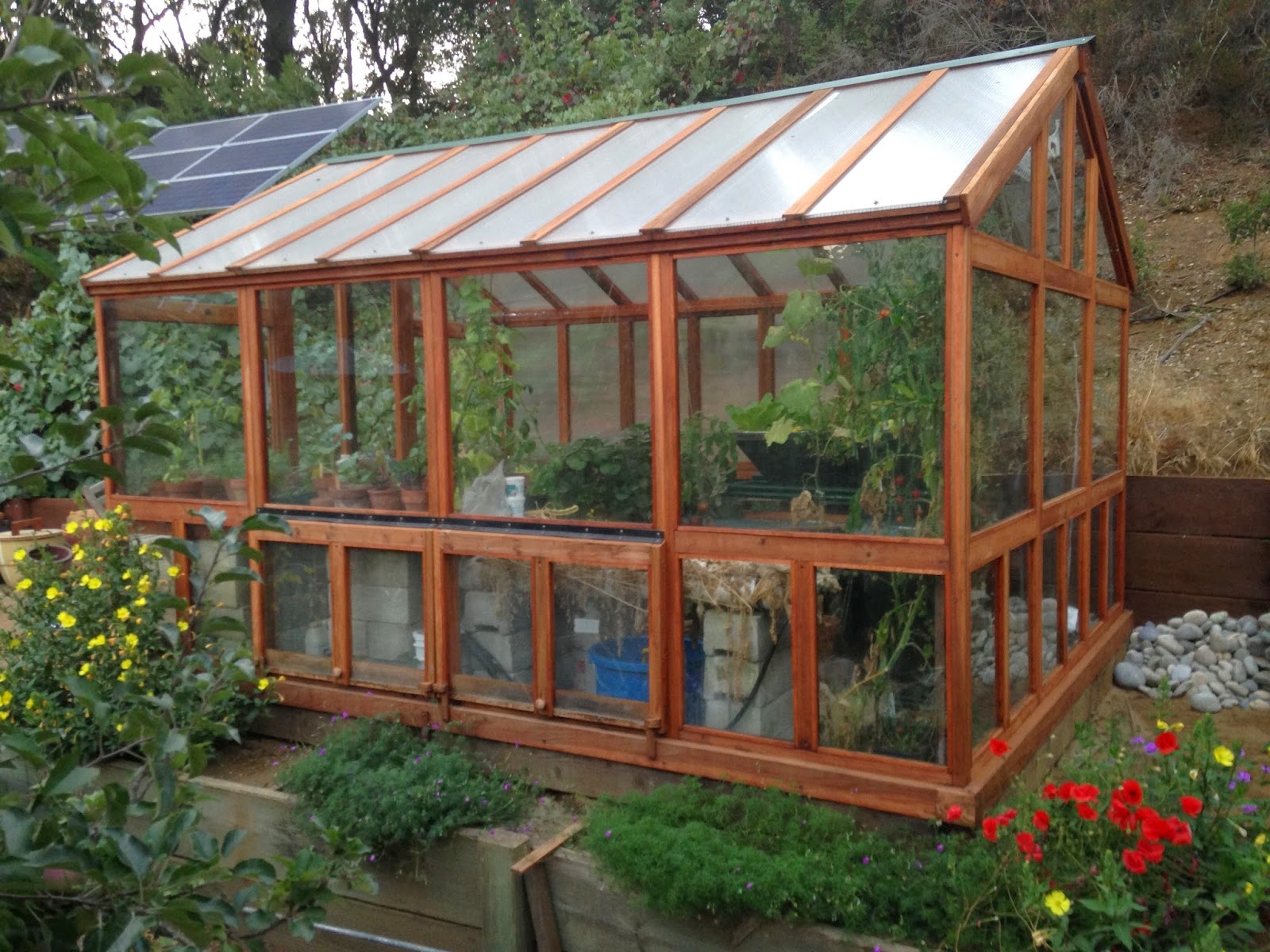
            Last weekend my son and I planted romaine lettuce seedlings in Andy’s aquaponics project in the greenhouse. We have been eating Ceasar salad (my son’s favorite) from this project two or three times a week for the last few months. And we planted seeds to germinate in the greenhouse and become squash and bean plants that will grow in the veggie garden, carefully pressing the seeds that Andy bought last year into the soil. I know Andy is happy to see we are carrying on his work—and doing it together.


            My neighbor helped us with his backhoe the next day, and we placed a large stone on Gunner’s grave, which is in the barnyard. And my boy raked the ground and seeded new grass to grow. We sprinkled the grass seed to get it started. The horses watched us from their corrals and nickered occasionally, telling us it was lunchtime. When we were done we gave them some hay and sat down on Gunner’s rock to survey our work. And again, I felt Andy smiling. We are tending the garden that Andy and I created together. Our little life as a family goes on. And horses are a part of it.


            This is what horses are to me now. I know that many of you have gone through similar cycles with riding/not riding, and I would be interested to hear your insights on this subject.

Wednesday, March 25, 2015

Butterfly


                                                            by Laura Crum

            My life is up and down right now. Ever since my husband died I have struggled so much. But I wouldn’t expect it to be different. I have moments where I feel him guiding and protecting and just being a companion to me, and I am comforted. I have moments where I realize that I am getting everything done and I feel stronger. Our son, our animals, our garden, and our little life here on our property are being taken care of just as Andy would want.  But sometimes I miss his physical presence so much that I can hardly bear the pain. I imagine it is the same for all those who have lost much-loved others to death.
            The other day I had one of those very sad moments. I literally cried out to Andy for help. And then, as I tend to do, I went outside and began doing something “useful.” I pulled some old, aphid-covered kale out of the veggie garden and fed it to the chickens, in preparation for planting new seedlings. While I worked there, a butterfly came and landed right next to me. It was a beautiful black and orange butterfly (I think a Red Admiral, but I am no expert on butterflies), and it was a foot from my hand. I stared at it, unable to resist a smile, feeling sure it had been sent as a messenger by Andy (and yes, this is the sort of fanciful thinking that is automatic to me now—seeing magic in the most every day things). I moved to another part of the garden, and again the butterfly lit on the ground very close to me. I watched it for a minute and then it flew up the hill toward Andy’s greenhouse.
            When I was done in the garden I went to the greenhouse to water the plants. Only to find what seemed to be the same butterfly trapped inside, fluttering against the glass, trying to escape. I can only assume my friend from the garden had flown in the open greenhouse door. I did my best to shoo him back out the door, but the butterfly resisted my efforts, determined to fly out through what appeared to him to be openings, which were in fact unyielding glass. I had to be very gentle in my efforts to coax him toward the doorway for fear of damaging his fragile self. Every time I had almost got him to freedom, by waving my hands…etc, he would fly back towards a pane of glass—away from the open doorway.
            I was almost crying with frustration, saying out loud, “Please let me help you. Please let me save you. Please.”
            And finally I was able to encourage the butterfly out the open door and it flew away into the spring afternoon, free at last.
            I felt so relieved, and I had the momentary thought that I had “saved” Andy. And then suddenly a very powerful thought came rushing in and I stopped dead in my tracks. What if it was the other way around?
            What if I am the butterfly and Andy is “me?” What if I am spending my life, like most humans, moving toward what appear to me to be logical ways to find happiness and freedom, but which are in fact completely unworkable dead ends—unyielding panes of glass. They look like you can go that way—but you actually can’t. It will never work. I am like the butterfly—I can’t see where the way to true freedom lies. Like all of us who are still in our human bodies.
            And perhaps Andy is now “me,” someone who can see the big picture and is trying as hard as he can to guide the butterfly (the still-human me) toward the only doorway to freedom. He can’t push me too hard or he will damage my fragile self—remove my ability to choose. He can only encourage me as much as he can in subtle ways. But he is trying so hard to help me. He is begging me to let him help me. He wants me to find happiness and freedom, and he knows the way.
            As a butterfly, I can’t perceive him as anything other than a big force, like an especially animated tree in the wind. He doesn’t seem like a visible “being” to me. I would only recognize another butterfly (read human being) as a proper being. But in fact he is very much a being, one who sees the big picture much more clearly than I do, and is trying to help me—and CAN help me, much more than another butterfly could. I just have to respond to his guidance.
            This concept hit me so hard I had to stop what I was doing and go lie for awhile in the hammock that hangs in a big oak tree at the top of our property, and think it over. The hammock is a place that is special to Andy—not only did he lie there in life, but he came to me in a dream and invited me to lie in the hammock with him. So now when I really need to feel our connection, I often go lie in the hammock.
            Lying there, looking up at the oak tree branches against the sky, I thought about the notion that I was the butterfly, and that Andy’s presence as he tries to guide me toward freedom and happiness might appear to me as some arbitrary happenings that push me one way or another, or a random force, like wind moving a tree. And as I had this thought, a wind sprang up and began to blow. It blew like crazy for about five minutes, rocking the branch that held the hammock, scattering leaves on me, ruffling my hair. I lay in the swaying hammock, as leaves fluttered down like kisses, somewhat amazed. And as quickly as it sprang up, the wind died away completely.


            When I finally got up and walked back down the hill, I had one simple thought. “Let me be open to this guidance.”
           

            So, anyway, I’m telling this story not to convince anyone of anything. My tendency to find magical guidance in everyday events may be nothing more than my imagination desperately trying to find a “story” to comfort my sense of pain and loss. But I really don’t care if this is so. I’m hoping that perhaps a few others out there (especially those who have lost someone they very much loved) may find that these thoughts resonate for them and perhaps will draw some inspiration for their own lives.  And I would love to hear your own magical stories.
            

Tuesday, February 17, 2015

Sad


                                                            by Laura Crum

Once again--don't read this post if you want to read about horses and writing and cheerful things like that. This is yet another post about life and death and grief.


            We mostly spend our lives trying to avoid being sad. If we are sad we feel something is wrong and we strive to make adjustments so that we can be happy again. We leave a relationship and seek a new partner, or leave a place for another place, or sell a horse and buy a different one, or take anti-depressants…etc. Sometimes these changes/choices do make us feel happier. I’m not saying that’s a bad thing.
            But I am seeing sadness a bit differently these days. Since my husband died I have been trying to come to terms with being sad. I don’t think I can run away from it. If I left my home and all that reminds me of my husband, I think I would be even sadder. I don’t have any interest in a new partner. I can hope that I will eventually feel calm, and as if I can deal with life on these terms, rather than desperate and afraid that I just can’t live this way, but I think I will always be sad. Maybe sad is not a bad thing?
            I struggle with this a lot. Despite all that I still have (and I have many good things—a lovely son, sweet dogs, good horses, a beautiful property, friends who care about me), my life can seem very empty and meaningless. I know that many people would love to have my life—they might even take it with a little grief thrown in. I spend my days taking care of the critters and the garden and my son. There are many, many worse ways to live. Still, at times I  am drowning in sorrow. Grief swallows up the beauty and all I can feel is the sadness of what I have lost. I have worse days and better days, but every day is sad. Sometimes sad but peaceful and I can smile a little, but sometimes despairing.
            Facing mortality head on, as I am being forced to do, tends to bring up the response of sadness—however it happens. Whether your horse or dog has just died, or you drive by a clearly fatal traffic accident, or you read about some sweet, innocent stranger who died young from disease, or you see a dead kitten on the shoulder of the road…well, you feel sad. Sadness is the appropriate response, it seems to me, to the constant loss of life that is our world. If we stop to think about it, it simply is sad. Every single one of you who has lost a loved animal need only dwell on that loss a bit, and then reflect on the fact that you will also (if you haven’t already) inevitably lose loved people or they will lose you, to see that yes, sadness is inherent in life.
            I’m not saying that joy isn’t present, too. But always entwined with sadness—two halves of a whole. Andy and I had a happy life together as a couple, and there was much joy. And now there is sadness in the loss of his human life. Both the joy and sadness are real. Just as the moments of joy you shared with your old dog are intertwined with your sadness at his death. It’s the nature of life. Maybe opening one’s heart to sadness, rather than seeing it as something wrong that needs to be fixed, is the answer?
            Maybe if I can embrace sadness as completely as I embrace joy, can see it as something to be felt with an open heart, rather than fought, can accept it as part of the nature of life—maybe then I will feel whole again? Joy and sorrow intertwined is the nature of life itself, and my own little life is part of this tapestry.  Love is what weaves it all together.
            If I believe one thing about this life, it is that death is not the bottom line. If it were so, all religions, all spiritual beliefs, are meaningless. But if death is not the bottom line, and our spirits go on, then it seems clear to me that the only possible bottom line is love—however you want to view this. And if this is so, then I can be sad over the death of Andy’s human body and the loss of his physical companionship here in our home, but believe that his spirit and our love for each other are still present. Joy and sorrow intertwined.
            So I am working on accepting my sadness and trusting that it can lead me somewhere. Somewhere I am meant to go. Somewhere that will bring me a gift that I am meant to have. I can trust that Andy is with me. It harms no one if this is all in my mind. Trusting in love is not a bad thing.
            But one thing I can say for sure. It’s not an easy thing to do. This is a very hard, sad journey so far.

Wednesday, January 28, 2015

Imagine It


                                                            by Laura Crum

            This is going to be a short, sad, somewhat bitter, and unsettling random post. Don’t read it if you don’t like the sound of that.

            Since my husband died I have had so many people talk/write to me about how they can’t imagine what I’m going through, and referring to my “unimaginable” loss. I know they mean well. But lately a certain bitter truth keeps trying to jump out of my mouth. So here goes.
            Imagine it, people. Because you will be faced with it. If you love someone, either you or that someone will inevitably be facing what I am facing now—some day or other. The pain of loss is part of this mortal life. Most of us have lost loved dogs and horses and understand that grief. But some day you will lose your husband or wife or child or much-loved person of some sort, and/or they will lose you, and this pain will be your/their lot, as it is now my lot.
            I’m not sure why I want to say this. I only know that it keeps coming up for me, so I decided to put it out there. I loved and still love my husband very much. I always understood that death is part of life. I’m coping with the pain as well as I can, doing the things that need to be done so my son’s life and our critter’s lives can go on. I think it would be even worse for me if I had somehow been blind to this inevitable ending of the mortal life and felt unjustly cheated. As if my husband wasn’t supposed to die.
            But I know that we all die. And none of us know when we will die. We, or our loved others, could die tomorrow. Including our much-loved horses and dogs and cats. This is the way it is. Best to be clear. Possibly best if you imagine it ahead of time. Because Andy and I did some practical things based on our clarity that we might die that are definitely a help to me now. And, as I said, despite how desperately I miss him, I am spared that angry, I’ve-been-cheated feeling. Because I did and do understand that we are not in any way guaranteed any special length of life. I am grateful for the years we had together. I am grateful for the happiness we shared and the family we became. I will allways love him. I will always miss him. I truly believe his spirit watches over me and our son. And death is part of life. So imagine it.
            

Wednesday, January 14, 2015

Life and Death


                                                by Laura Crum 

            To those who have followed this blog for awhile, I want to say that I am sorry about my recent lack of posts. Losing my husband in November has been the hardest thing that I have ever gone through and it is all I can do to get the things done that must be done. I am not writing to speak of, or riding at all. So I have nothing to say that pertains on a blog about horse-themed fiction.
            However I know that some of you have been interested in my horses and “knew” them through my books and this blog, and perhaps would want to know that I had to put Gunner down about two weeks before my husband died. I did not grieve over much about Gunner—he was 35 years old and had a very good life. He had been getting steadily lamer on his arthritic knee, harder to keep weight on, and more prone to anxiety, due to loss of sight and hearing and typical old horse dementia. So when I saw that he was lame in both front feet one morning at feeding time, I did not bother with diagnostic work. I knew it was time and my vet agreed. We both think the cause was laminitis, but it truly doesn’t matter. Even if it was an abscess in the “good” front, it just wasn’t something I was going to try to take Gunner through, under the circumstances.
            My husband was in the hospital at the time, and I spent all day, every day with him, but Andy totally supported me in going home to be there when Gunner was put down. I have been there for all my horses and I wasn’t going to fail Gunner, who had been my horse for thirty two years. I let him out to graze for a while that morning, and was happy to see that not a rib showed, and the old horse’s enthusiasm for grazing was undaunted, despite the lameness. Gunner was himself right up until his end.
            And his end was quick and clean. The vet tranquilized him and I petted him and told him how much I loved him and when he was ready I sat in the barn for the brief minute that it took for the kill shot to take effect and for Gunner to fall. There was no struggle. Gunner is buried where he grazed that morning and I am happy that I could give him a good life and a good death.
            As for me, I would at times be happy to have that good death, but that isn’t a choice that I will ever make for myself. My son and our animals depend on me and I am taking care of them. I may not be riding, but Sunny, Henry, Plumber and Twister are all thriving, sound, and in good flesh and happy—so nobody needs to worry. Dogs, cats and kid are all fine, too. The garden is tended. I’m doing what I know my husband would want me to do.
            I’m not sure what else I can possibly have to say right now. I walk through each day, one step at a time, getting things done that need to be done. I haven’t any interest in social things at the moment, including facebook and the social life of the internet…etc. I hope you all are doing well, but I cannot face chatting about every day, normal things. I appreciate the kind wishes that have been sent to me and I wish all of you the best. I especially appreciate those of you who have reached out to me and done what you could to show love. It helps.
            I will try to keep posting here, but my posts may be a bit random and are not likely to be very cheerful. This is just how it is for me right now. Those of you who have read my books may know that my husband was the inspiration for the character “Blue Winter.” Go re-read Slickrock or Hayburner or Forged if you’d like to get a small inkling of what a wonderful person he was and is to me.
Death is part of life. But it can be very hard to bear.
            

Wednesday, February 12, 2014

Saying Goodbye


                                                            by Laura Crum

            We said goodbye to our old dog, Jojo last week. I can’t really find words for how sad we all were, but those of you who have lost a loved animal already know without my telling you. I can find some comfort in the fact that Jojo was 16 years old, a good long life for a dog. Jojo’s 16th birthday was Superbowl Sunday. She was born on Superbowl Sunday sixteen years ago—the Broncos were in it that year, too. And this year, on her 16th birthday, Jojo began to fail.
            She had been living with a host of old animal problems—congestive heart failure, kidney issues, vertigo, poor hearing and sight, a mild dementia. But overall, she seemed happy, her appetite was good, she would play a bit with our young dog and hopped on the bed every night to sleep. She did the chores with me and could still go on short beach walks. All this was true right up until a week ago Saturday.
            That night Jojo was very uncomfortable and got us up many times. And on Sunday she would not eat and was clearly very down. We gave it a couple of days, because Jojo had come through several setbacks and been OK a few days later. I did not take her to the vet. I will not ever again put a very old animal through diagnostic work in an attempt to prolong its life. In my experience (and I have gone this route when I was younger), the animal merely goes through some unnecessary grief before it is euthanised. And so we kept Jojo as comfortable as we could and waited to see if she would improve.
            By Tuesday I knew that she was failing. Her eyes and gums had a yellowish cast, which indicates liver failure. She would drink water, she could totter around—barely. She would not eat. She lay on the couch all day and I petted her and told her what a good dog she was. She seemed weak, but peaceful. She took a couple of short strolls and lay in the sun while we did chores. But her breathing was a little labored. I made the appointment for my vet to come out the next day.
            I have to admit, I really hoped that Jojo would pass on her own that night. I have friends whose dogs died quietly in their sleep. I always think this would be such a blessing. But it never happens for me. And so again, I held my loved animal while the vet administered the kill shot.
            Jojo died very peacefully, here at home, on the couch. The vet has known her since she was a puppy. I stroked her and told her I loved her. And her spirit went free.
            I am so sad. But I am also accepting. This is what it is to love an animal. This is life. Jojo was sixteen years old. If I had a wish, when she was a sweet little blue-eyed puppy, it might have been that she would live to be sixteen and have a happy life. That wish has come true.
            Jojo was our dog before we had a child. My little boy has never known one moment of life when she was not his companion. She crossed the country with us on our camper trips to Michigan seven different times. She camped with us in the Sierras and hiked with us through the coastal hills and on the beach so many, many times. She raised our little dog, Star, with good grace, just as she raised my little boy. Jojo has always been a very sweet dog. Those of you who have read my mystery novels will realize that she is the model for “Freckles.”


            We buried Jojo under the apple tree and we cried for her. One more sad thing. But not an entirely sad thing. Jojo, our sweet dog, had a good long life and we loved her and did our best for her right up until the end. She had a peaceful passing after one not-good morning. This is pretty much the best outcome life has to offer.
            Good-bye Jojo. We love you.