by Laura Crum
This post has been in my mind a long time. Because I occasionally read other blogs (when I have time) and some, particularly Joe’s TBFriends blog, are about rescuing horses. I read this blog and I think, I wish I could take on another horse. I wish I could help Joe in this noble work. And I do believe it is a noble work. But I always add things up and realize I can’t. I don’t have room or time for another horse, let alone I can’t afford the cost. I still feel sad about it. There are so many horses that need help.
I said as much to a cowboy friend the other day, and he looked at me like I was nuts. “Laura,” he said, “you already take care of seven useless horses. What more are you supposed to do?”
Well, I thought about that. I do take care of seven retired/rescued horses. Three were rescued from others for one reason or another, four are horses I rode that were retired due to age or injury. Some of them have been in this group of pasture horses for over twenty years.
My friend said, “How many people do you know that have taken care of a perfectly useless horse for over twenty years?”
That really made me think. I know there must be plenty of others in the world who have done and are doing this. There are people who write for this blog and who write in the comments that I know are taking good care of their retired/rescued horses. But I also know that there are so many so-called “rescues” that come and go, after taking on more horses than they can care for, frequently leaving a legacy of dozens of half starved horses that yet another rescue has to take on.
I thought about what it really means to retire a horse—and believe me, I know. Years and years (sometimes over twenty years) of usually escalating cost, as the horse needs senior feed and more vet care as he gets into his late twenties and thirties. And if you are a responsible horseman, you make sure the horse has pasture or adequate turnout time—it is not doing any horse a favor to keep him in a small pen the rest of his life when he can no longer be ridden. And then, there are the final months/years when you agonize over whether his quality of life is good enough, as he grows more stiff and sore or has health problems. Finally you make the call and with much sorrow, end his life as peacefully as possible, paying quite a bit for this privilige. This, all this, is a huge investment in time and money and emotional energy.
So today I want to send out a huge thank you, not to those who rescue horses, even though I totally admire the good horse rescues out there, but to each and every one who does retire their riding horses when they become too lame or old to use. Thank you so much for your kindness and love. If every horse owner were like you, no one would need to rescue horses. All horses would have a good life.
And I want to make a plea. Please, even if you, like me, can’t afford to take on a rescue horse right now, make a plan to retire the good horses you have when their riding days are done. Selling them to a “good home” does not cut it. Not unless you remain responsible for them and keep checking on them and are willing to take them back if needed. I can tell you dozens of stories of older horses who were sold to a “good home” and ended up going down the road…to an eventual fate we all can guess.
Yes, sometimes older horses do get a good home. Henry got one with me at nineteen years of age. Sunny, too. Because I am going to retire my two good little trail horses when their using days are done, even though I bought both of them as teenage horses. But sad to say, I’m afraid this is the exception not the rule.
So this is the point of today’s post. A huge thank you to all the unsung heroes of the horse world who do retire their horses when they are no longer able to do a useful job, and a plea that more people consider this. I truly believe you will be earning much good karma, if that matters to you. I know it isn’t always easy or convenient. But it’s the right thing to do. Keep your good horses and retire them when their working life is done!
And if you keep a few “perfectly useless horses,” to quote my friend, and have done so for years, I'd love it if you'd write and tell me. I know that quite a few of you do this—it cheers me up to realize I’m not alone. I’m sure we can all share stories both about how expensive and time consuming this can be—and the smile it brings to your face to see your old horse looking and feeling good on green grass. I think, of all the fun things I have done with horses, this may be my favorite. The joy of knowing that my old friends are having a good life—after all the gifts they gave me—well, its hard to describe how rewarding it is. Perhaps some of you can do a better job than I can. Any old horse stories to share?
Showing posts with label retiring horses. Show all posts
Showing posts with label retiring horses. Show all posts
Wednesday, December 8, 2010

Wednesday, November 17, 2010
Life is a Rollercoaster

I quite like Ronan Keating. He’s the lead singer of that recently reformed Irish boy band, “Boyzone”, as well as a solo artist. I’ve seen him live twice; once about a decade ago in Zurich, performing with Boyzone (a somewhat disappointing concert; Ronan was clearly in a foul mood that night), and then again about four years ago when he gave a private solo concert at a chi-chi event my husband and I were invited to (smiles, twinkly eyes, and Irish charm all around!). Do you know Ronan Keating? He’s the guy who sang “When you Say Nothing at all”, the theme song for the romantic comedy “Notting Hill”, starring Hugh Grant and Julia Roberts. He has a nice voice, and he’s kind of cute.
At this point, I guess you’re wondering why the heck I’m rattling on about Ronan Keating on Equestrian Ink. Well, simply because I’ve had one of his hit songs, “Life is a Rollercoaster”, stuck in my head for the past week. It’s been pursuing me ever since I hit this wall of sad truth: Kwintus’ dressage career is over. Actually, it’s worse than that. Kwintus won’t be being ridden again.
Yes, life really is a rollercoaster,as maybe you’ll remember that the last time I blogged here, two weeks ago, my equestrian horizon was all blue skies, sunshine, and a happy, healthy, fully recovered horsey. That first ride in over two months was a dream (which is why I so related to Jami’s post on Sunday, although I read it with tears in my eyes, having already made my decision): Kwintus felt so…enthusiastic and youthful and bouncy. But the days that followed brought me back to earth with a bump. No, I didn’t fall off, but the way he started to stumble again brought back memories of close calls with hard surfaces. Falling off a horse is never fun, but having a horse fall away from underneath you is a truly horrible sensation. Also, a few days into his return to work, he started throwing his head in the air and yanking the reins out of my hands, something he’d only ever done when suffering from a pain in his upper neck. He also felt stiff and tired, and…well, just blah. But what really freaked me out was that tackling the slightest incline was clearly unpleasant for him. The way he shuffled down the not-so-steep hill leading from the stable block to the private road, making teeny-tiny steps, catching the tips of his front feet on every other surface irregularity was hard to watch. So, last Friday, with lead in my heart, I took him for a short hack to the next village, feeling terribly unsafe on his back as we inched down the gently sloped trail beneath the trees. He must have stumbled four or five times. Twenty minutes later, I dismounted. For good.

I could call in the top osteopath in the country. I could cart Kwintus right back across Switzerland, have him x-rayed from head to toe, and then infiltrate every creaky nook and cranny. I could. But it would be wrong. He’s going to be nineteen next year. He’s worked hard all his life, giving all his owners (I reckon he’s had about 5) his very best. He gave me back my confidence when I lost it to a rearing, twirling youngster. He taught my daughter and me flying changes, pirouettes, half-pass, piaffe and passage. He won first place for my daughter during their first competition outing together. He’s been an amazing horse. He’s had an amazing career.
But it’s time to lay off and let him take it easy.
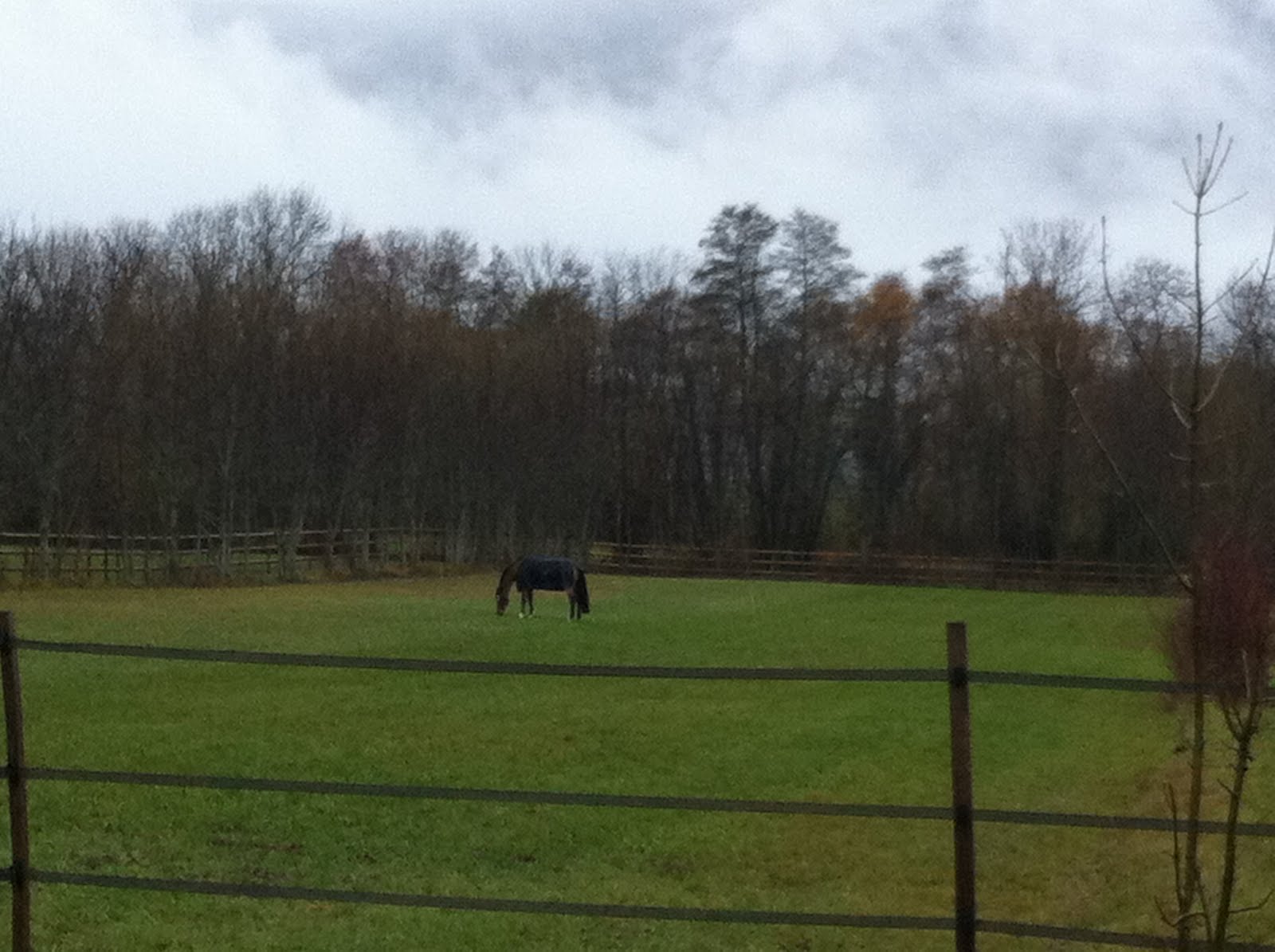
And so Kwintus is officially an OAP (old-aged pensioner) as of last weekend. He will spend the rest of his life strolling around the huge pastures surrounding Stephanie’s stables, initially alone as he’s still wearing shoes (I shod him ten days ago, so his feet need to grow a little before we can take his shoes off), and later in the company of Stephanie’s old, retired eventer.
I’ve shed numerous tears this week, and hauled back buckets loads of other. I’ve never enjoyed riding any horse as much as I’ve enjoyed riding Kwintus. Heck, I’ve never loved a horse as much as I love Kwintus! So I’m therefore extremely grateful to Steph for letting him stay on at her place, as the last thing I want to do is send him off to a retirement home for horses hundreds of kilometers away, which would mean no longer being able to see him regularly.
So there it is. In the space of one week I went from ultra high to mega low. Now? I’m coping. Okay, so I’m a little blah. But I’m also at peace with my decision. There’s comfort in knowing that I did everything I could for my horse’s wellbeing, that I can get off this particular rollercoaster, that I’ll no longer keep second guessing myself over whether or not Kwintus had really reached the point where he was dangerous to ride.
My equestrian future? Meh, it’s sort of vague. I’ll give myself some time, get through the winter. Come spring, I’ll hopefully be able to start searching for another horse, hopping on a whole new rollercoaster.
Right now, I’m just hanging with Ronan Keating. Go on, sing it to me, Ro! Life is a rollercoaster, just gotta ride it…
Saturday, January 23, 2010
One Horse's Story
by Laura Crum
In the discussion following my last post stillearning raised some great points about the issue of selling a horse you feel you can no longer keep. She referenced the idea that it may just be ego that tells us we are the only ones who can deal with this horse’s issues. I agreed with her that there may very well be others who can deal with the horse’s issues as well or better than we can, but is their loyalty to the horse going to be as high as ours, who trained him and owned him for many years? Perhaps he worked his butt off for us, acquiring his issues along the way. I suggested that we owe him at least keeping track of him and taking him back if need be, to be sure he doesn’t come to a bad end. And I referenced my first horse, Jackson, who was mentioned in my previous post.
Well, it occurred to me this morning, reading stillearning’s last comment, that Jackson makes a great illustration of the point I am trying to make. So here is his story.
I bought Jackson when I was fifteen years old. I had saved my money for many years and hounded my parents, and I was finally permitted to buy a horse of my own. My cowboy uncle was my trusted advisor. We tried many horses, but my uncle liked Jackson, who looked like a rope horse (15.3 and strongly made). We found the horse through an add in the paper; he was dirt cheap, and the woman who owned him said he was gentle. She’d owned him for two years, she said. He was fourteen years old. She was clearly a novice, and was able to walk, trot, lope the horse around her little ring. My uncle and I rode him and we bought him that day. That’s all in the world we knew about him.
I owned Jackson for three years. He turned out to have some issues. Though gentle to walk, trot, lope around a ring, he did not care for solitary trail rides and would rear vertically to make his point clear. I dealt with it. If put under pressure to load, have his feet worked on, and at certain other times, he would kick out, hard. I learned to be careful. He did not care for being a rope horse and tried some pretty violent evasions. Fortunately nobody was hurt.
When I had owned him three years, I decided I wanted to buy a young horse to train. I was not so attached to Jackson and sold him, as my previous post describes, to the riding school where I used to take lessons. The fact that he did not end up at the saleyard is pure luck. (See my post--"What Do We Owe Them?" for more on this.)
Here’s my point. When I was trail riding Jackson one day I met a middle aged lady on a horse. She looked at my mount and asked me his name. When I told her she said, “I raised that horse and trained him myself.”
I kept quiet about the training.
She asked where I got him and I told her.
She said, “I sold him to that gal when he was twelve. She was just a beginner and wanted a gentle horse. I sold him cheap because she said she’d give him a good home.”
And I could tell this lady was not pleased. She had not expected that her horse would be sold again in two years. And this time to a fifteen year old girl. But she had clearly not kept track of the horse. And she did not offer to buy him back if I wanted to sell him. She simply rode on, on the younger horse she now had.
When Jackson was seventeen I sold him to a riding school. I was tired of his issues, which were not of my making. As I said, it is simply luck that he didn’t end up at the sale and get bought by the killbuyers. So, I think it is a point worth making, that, as long time owners and trainers of a horse, we may have a little more loyalty to that horse and an acceptance of his issues, since we know exactly how he got them. They are usually due to our own choices. Someone who has owned the horse for a couple of years and didn’t create his problems may feel quite free to pass him on. It may not be ego to suppose that we are more likely to take good care of this horse when he gets old and give him the retirement and dignified death we might feel we owe him in exchange for all the years of work he has done for us.
Again, I’m not suggesting that we all need to keep all of our horses. I know its not always possible. I am wondering, however, if we don’t owe our horses something, if we have owned them a long time, and made the choices that created the issues they have, lameness or otherwise. I guess I’m asking if we don’t at least owe it to keep track of them and be sure that they don’t come to a bad end. Which means be willing to take them back. The problem, however, which I understand very well (because its happened to me), is that we often get these horses back when they really have no more useful riding horse years left, but may have many years as a pasture pet…which is all about taking care of them and writing checks to pay for their care…and not about riding and having fun. So, there’s the question in a nutshell. Do we owe them that?
I am asking a question--I'm not saying I know the answer. My own opinion, for what it's worth, is that I do owe my horses that, and if it's financially impossible for me to keep my retirees any more (which may well happen), then I owe them that dignified death. I am not at all adverse to letting someone else care for them (and write the checks) as long as I continue to be responsible for them and have enough control over their fate to be sure they don't end up starved or otherwise abused (or dumped at the sale.)
As always I welcome hearing your thoughts on this. Its a complicated subject, because we all have different circumstances. And yet everyone who has owned a horse for a long time will probably understand how critical it is that we as responsible horsemen give some real thought to what we owe these horses.
We’re still looking for more authors to feature on our Reader’s Write Saturdays. Send us a short piece of fiction, your favorite blog post from your own blog, or anything you think might interest our readers. Send it to Jami at jamidavenport@att.net
In the discussion following my last post stillearning raised some great points about the issue of selling a horse you feel you can no longer keep. She referenced the idea that it may just be ego that tells us we are the only ones who can deal with this horse’s issues. I agreed with her that there may very well be others who can deal with the horse’s issues as well or better than we can, but is their loyalty to the horse going to be as high as ours, who trained him and owned him for many years? Perhaps he worked his butt off for us, acquiring his issues along the way. I suggested that we owe him at least keeping track of him and taking him back if need be, to be sure he doesn’t come to a bad end. And I referenced my first horse, Jackson, who was mentioned in my previous post.
Well, it occurred to me this morning, reading stillearning’s last comment, that Jackson makes a great illustration of the point I am trying to make. So here is his story.
I bought Jackson when I was fifteen years old. I had saved my money for many years and hounded my parents, and I was finally permitted to buy a horse of my own. My cowboy uncle was my trusted advisor. We tried many horses, but my uncle liked Jackson, who looked like a rope horse (15.3 and strongly made). We found the horse through an add in the paper; he was dirt cheap, and the woman who owned him said he was gentle. She’d owned him for two years, she said. He was fourteen years old. She was clearly a novice, and was able to walk, trot, lope the horse around her little ring. My uncle and I rode him and we bought him that day. That’s all in the world we knew about him.
I owned Jackson for three years. He turned out to have some issues. Though gentle to walk, trot, lope around a ring, he did not care for solitary trail rides and would rear vertically to make his point clear. I dealt with it. If put under pressure to load, have his feet worked on, and at certain other times, he would kick out, hard. I learned to be careful. He did not care for being a rope horse and tried some pretty violent evasions. Fortunately nobody was hurt.
When I had owned him three years, I decided I wanted to buy a young horse to train. I was not so attached to Jackson and sold him, as my previous post describes, to the riding school where I used to take lessons. The fact that he did not end up at the saleyard is pure luck. (See my post--"What Do We Owe Them?" for more on this.)
Here’s my point. When I was trail riding Jackson one day I met a middle aged lady on a horse. She looked at my mount and asked me his name. When I told her she said, “I raised that horse and trained him myself.”
I kept quiet about the training.
She asked where I got him and I told her.
She said, “I sold him to that gal when he was twelve. She was just a beginner and wanted a gentle horse. I sold him cheap because she said she’d give him a good home.”
And I could tell this lady was not pleased. She had not expected that her horse would be sold again in two years. And this time to a fifteen year old girl. But she had clearly not kept track of the horse. And she did not offer to buy him back if I wanted to sell him. She simply rode on, on the younger horse she now had.
When Jackson was seventeen I sold him to a riding school. I was tired of his issues, which were not of my making. As I said, it is simply luck that he didn’t end up at the sale and get bought by the killbuyers. So, I think it is a point worth making, that, as long time owners and trainers of a horse, we may have a little more loyalty to that horse and an acceptance of his issues, since we know exactly how he got them. They are usually due to our own choices. Someone who has owned the horse for a couple of years and didn’t create his problems may feel quite free to pass him on. It may not be ego to suppose that we are more likely to take good care of this horse when he gets old and give him the retirement and dignified death we might feel we owe him in exchange for all the years of work he has done for us.
Again, I’m not suggesting that we all need to keep all of our horses. I know its not always possible. I am wondering, however, if we don’t owe our horses something, if we have owned them a long time, and made the choices that created the issues they have, lameness or otherwise. I guess I’m asking if we don’t at least owe it to keep track of them and be sure that they don’t come to a bad end. Which means be willing to take them back. The problem, however, which I understand very well (because its happened to me), is that we often get these horses back when they really have no more useful riding horse years left, but may have many years as a pasture pet…which is all about taking care of them and writing checks to pay for their care…and not about riding and having fun. So, there’s the question in a nutshell. Do we owe them that?
I am asking a question--I'm not saying I know the answer. My own opinion, for what it's worth, is that I do owe my horses that, and if it's financially impossible for me to keep my retirees any more (which may well happen), then I owe them that dignified death. I am not at all adverse to letting someone else care for them (and write the checks) as long as I continue to be responsible for them and have enough control over their fate to be sure they don't end up starved or otherwise abused (or dumped at the sale.)
As always I welcome hearing your thoughts on this. Its a complicated subject, because we all have different circumstances. And yet everyone who has owned a horse for a long time will probably understand how critical it is that we as responsible horsemen give some real thought to what we owe these horses.
We’re still looking for more authors to feature on our Reader’s Write Saturdays. Send us a short piece of fiction, your favorite blog post from your own blog, or anything you think might interest our readers. Send it to Jami at jamidavenport@att.net
Wednesday, January 20, 2010
What Do We Owe Them?
by Laura Crum
The other day I was thinking about the riding school where I took lessons as a kid. And I began to remember my favorite lesson horses. Melody and Gypsy, the two old mares who were my mounts when I was just a beginner. Dusty, a horse I actually progressed to jumping three and a half foot fences on (pretty good for a thirteen year old who had previously only ridden western). Peg, on whom I learned vaulting, and won many a bareback class. And there were others. Rhonde, Uncle Max, Thunder, Freckles…all were my favorite at one time or another.
I took lessons at that riding school for many years. I went to their summer camp program. I knew their horse herd well. And they had almost a hundred horses. They took pretty good care of these horses. The horses were turned out every night in a big pasture and fed hay every morning in the corral; the ones who were to be used were then caught for the day. No horse was thin. Lame horses were not ridden. The horses did get vet care. If a horse was old, that horse only had to give a few lessons a day. Many times I heard the instructors refusing to let the more advanced kids ride Gypsy and Melody, telling them that the old girls should not be used too hard. In short, it was not a bad place.
Still, I have little doubt that when these horses’ time was done, they were hauled to the local saleyard and bought by what, in those days, was called the “chicken man”. The guy who bought horses for chicken food. This was just what most people did at that time. It was taken for granted.
Now, I have a confession to make. I sold my first horse, an ornery bay gelding named Jackson, to this riding school. Jackson was not a particularly endearing or successful first horse—I have written a few times about the fact that he was prone to vertical rears and kicking (under certain circumstances), and that once he kicked me in the head and knocked me out cold. What my parents were thinking to turn me loose on such a creature I can’t imagine. But, if only asked to walk, trot and lope around a ring, Jackson was reasonably gentle. And when I determined to be rid of him and buy myself a young horse to train, I sold him to the riding school where I had taken lessons.
Jackson was a success there. I went up to visit him some years later and he was doing fine, well loved by the little girls who rode him. And no, he didn’t end up at the sale. I heard from a friend who taught there that he was kicked by another horse and suffered a broken leg. He was euthanized by the vet right there on the place. By that time he was over twenty, so, all in all, I’d say things worked out OK for him.
Now I didn’t train Jackson—when I bought him he was fourteen. I owned him for three years. I did not create his problems, and he left me a more cooperative horse than when he came to me. But also, I did not take responsibility for him. When I sold him I left him to his fate. Would I do that now? I’m not sure.
I think of all the horses I rode at the riding school, Gypsy and Melody and Dusty and Peg, all such good horses. I was grateful to them. I thought I loved them. As a child and then a teenager I never thought to ask what would become of them. I never thought of it as my problem.
I think of other horses I owned at one time and then sold. I don’t, to this day, know what their fate was. Did they end up on a truck, bound for slaughter in Mexico? Was the basic trust I tried to instill in them when I owned them completely and finally betrayed? How much might they have suffered? It will always torment me, to some degree.
And this is what I am trying to do differently with my son. We talk a lot about our old, retired horses and why we retire them. We talk about being grateful to our horses and taking care of them until they die. My son goes with me when I feed the retirees. I am trying to show him, both in words and by example, that it is our business what happens to these horses, how they end their lives. It is definitely our problem.
I have no idea what effect this will have, of course. But at the very least I am hoping that when he looks back on the horses that taught him to ride, he will feel good to know that we took care of them and were there for them until the end. I am hoping that we can begin a new pattern. I am hoping that, unlike me, he will be free of this nagging sadness.
I’m grateful that I have had the resources to keep my horses, that I have not been forced to sell them out of financial necessity. But if I did have to sell some horses because I didn’t have enough money to keep them all, it would not be my older horses who would go. No, the horses who worked hard for me all their lives, whose quirks are the results of my training and my choices, these are the ones that I owe. I will honor my debt to them by making sure that they have the retirement they deserve. Its not that I think I am the only one who can take good care of a horse. Its that this is my responsibility, not someone else’s. It is my privilege to do right by these horses.
Believe me, I sure know how tempting it is to decide to offload a horse that is no longer useful to the owner. Its so easy to develop a convincing rationale for doing what would be most covenient for us, the human in charge. Maybe the horse is old, maybe it has issues, lameness or otherwise. For whatever reason, we, the owner, no longer want to ride this horse. And so often we have other, younger horses that we’d rather ride. Our older horse is taking up space, or costing us money, or taking time (usually all three) that we would rather devote to these younger horses that are our current interest. And so we decide to find the older horse a new home. We rationalize that it could be “better” for the horse, that the horse will get more attention. And sometimes this can be true. But what we are really motivated by is the fact that it will be “better” (more convenient) for us. We are justifying our ready excuses as to why we shouldn’t have to take care of a horse who has served us well and perhaps been injured, physically or emotionally, or perhaps just grown too old for the job we want to do.
I’m not saying that one should never find a new home for a horse. I have “rehomed” several horses in the last ten years that just didn’t fit my needs. But I always took responsibility for these horses. I didn’t sell them. I placed them in homes where I thought they would work. One lived happily in that home until he was retired and eventually euthanized. One is still living happily in his home. Three I had to take back. Why? Were they bad homes? Not at all. In two cases the people lost their jobs and could no longer afford the horse. In one case the woman went through a divorce and could no longer afford the horse. If I had not been there, ready and willing to take the horses back, if I had simply sold them and lost track of them, they would have been sold again. There is no way of knowing where they would have ended up. Thus, I believe that if one wants to rehome a horse and still be responsible, one needs to maintain control of that horse. Usually, this means not selling the horse.
I am currently facing this dilemma with my horse, Plumber, who features in my mystery series. I’ve known Plumber since he was born; I’ve owned him since he was three. I broke him and trained him myself. He’s been a competitive team roping horse since he was eight. He’s won several saddles, lots of money, numerous buckles and awards. He started to slow down at nineteen. Last year, at twenty, we used him very lightly. It became clear near the end of the season that Plumber just didn’t want to run hard any more. He also doesn’t care for steep hills. He’s still sound for walk, trot, lope type work on level ground. But he’s not really a kid’s horse. A little too flighty, inclined to spook and prance, rather full of his own ideas. (And all these issues are no doubt due to my failures as a trainer.) This spring Plumber will be twenty-one. He isn’t going to be much use to me as a riding horse, since I want to trail ride and the country where I live is very hilly. It would be fairly easy for me to find him a home if I gave him away. He’s gentle for an intermediate rider, kind, smooth gaited, no one has ever come off him in his entire life. He’s very safe. Lots of people would enjoy him. It would be convenient for me to have an extra pen and one less horse to take care of. So, am I going to rehome Plumber?
I don’t think so. I owe him. He’s my little horse and he did his best for me. It may not be convenient for me to keep him, but I’m going to, even if I have to eat mac and cheese, or make other sacrifices. I plan to keep him and retire him because I think that’s what would be best for him.
The writer of one blog suggested that horses don’t really get attached to us the way we do to them. No doubt this is true. Plumber nickers whenever sees me, including when he’s in a group of other horses…etc. Is he fine when I’m gone? Sure. But there is also no question that this little horse who has lived in the same big corral here on my property for seventeen years and been hauled to many, many events, and who has covered a great many miles under my saddle, is used to his people and his life. Could he accept change? No doubt. But what if I’m not trying to figure out a solution that’s convenient for me and might be acceptable. What if I want to do the best I can for this horse?
I’m not going to say that I know what’s the best thing for every owner of an older horse to do. I don’t. Plumber won’t get as much attention here as he would if he were somebody’s one special pet horse. I have four other saddle horses at my place that need my attention, as well as my other retired horses.
What I do know is that I accept responsibility for my horse who has done so much for me and seems so bonded to me and his life here. It isn’t about ego and thinking I’m the only one who can do it. Its about love and doing the best we can for the ones we love. Its about hanging in there when it isn’t easy or convenient. That’s what I want to teach my son.
When we sell a horse we lose control over that horse’s fate. That’s a fact. Its possible to rehome a horse and do right by him. As long as we retain control and keep track of how the horse is doing, it can be a good option; we need to be willing and able to take that horse back at any time—or his end may not be so pretty. But there’s a whole nother equation. And that’s about wanting to give back to the ones who gave to us. And yes, it sometimes is about eating mac and cheese (figuratively, anyway). We can delude ourselves that its not about that, but those are meaningless words. Unfortunately its often about making sacrifices so that we can do our best by our horses. Sometimes we need to do things that aren’t easy and convenient for us because its better for someone else. Often we need to stretch ourselves a little and look beyond what comes as the most “logical”, “natural” choice for us, the human owner. Sometimes we need to look at what would be best for a horse who has done a great deal for us. Maybe we need to consider what we owe them. And so I will continue to study on what’s the best path for my horse, Plumber, with an open mind and a willing heart. Because I really want to do what’s best for him….not just what’s convenient for me. And its my belief that Plumber, like me, loves his pleasant life and his companions and his familiar routines. And I don’t plan to take that away from him lightly.
The real question in my mind is whether it would be better for Plumber to turn him out with my other retired horses or keep him here at home and try to give him what attention I can. Plumber is a fussy critter, more like a mare than a gelding, prone to kicking at his companions in the next corral and squealing, and he is very, very used to his routines and very people oriented. In the pasture he would get far less attention, but much more freedom and grazing. The fences in the pasture are not perfect, though they’re decent, but still not as safe as my pipe corrals at home. I have never had a horse seriously hurt in this pasture (knock on wood) in over ten years of horsekeeping there. But I worry. Plumber is not the ideal candidate for turnout. If he made it through the transition, I’m sure he’d be fine, but would this fussy little people oriented horse be happier here or in the pasture?
If anyone would like to chime in with suggestions about the best way to retire a real “people horse”, I’d love to hear them. I’d also be interested in your thoughts concerning rehoming an older horse with issues (whether due to lameness, age or whatever) that are the results of one’s own training and choices.
And don’t forget about our Reader’s Write Saturdays. Send us a post about you and your horse, or short piece of your own fiction, or your favorite blog post from your own blog. Or your take on one of the many subjects we’ve brought up and discussed here. Anything you think might interest our readers. Send it to Jami at jamidavenport@att.net and she’ll post it on the next available Saturday. We’ve very much enjoyed all the contributions so far. We’d be glad to feature you soon.
The other day I was thinking about the riding school where I took lessons as a kid. And I began to remember my favorite lesson horses. Melody and Gypsy, the two old mares who were my mounts when I was just a beginner. Dusty, a horse I actually progressed to jumping three and a half foot fences on (pretty good for a thirteen year old who had previously only ridden western). Peg, on whom I learned vaulting, and won many a bareback class. And there were others. Rhonde, Uncle Max, Thunder, Freckles…all were my favorite at one time or another.
I took lessons at that riding school for many years. I went to their summer camp program. I knew their horse herd well. And they had almost a hundred horses. They took pretty good care of these horses. The horses were turned out every night in a big pasture and fed hay every morning in the corral; the ones who were to be used were then caught for the day. No horse was thin. Lame horses were not ridden. The horses did get vet care. If a horse was old, that horse only had to give a few lessons a day. Many times I heard the instructors refusing to let the more advanced kids ride Gypsy and Melody, telling them that the old girls should not be used too hard. In short, it was not a bad place.
Still, I have little doubt that when these horses’ time was done, they were hauled to the local saleyard and bought by what, in those days, was called the “chicken man”. The guy who bought horses for chicken food. This was just what most people did at that time. It was taken for granted.
Now, I have a confession to make. I sold my first horse, an ornery bay gelding named Jackson, to this riding school. Jackson was not a particularly endearing or successful first horse—I have written a few times about the fact that he was prone to vertical rears and kicking (under certain circumstances), and that once he kicked me in the head and knocked me out cold. What my parents were thinking to turn me loose on such a creature I can’t imagine. But, if only asked to walk, trot and lope around a ring, Jackson was reasonably gentle. And when I determined to be rid of him and buy myself a young horse to train, I sold him to the riding school where I had taken lessons.
Jackson was a success there. I went up to visit him some years later and he was doing fine, well loved by the little girls who rode him. And no, he didn’t end up at the sale. I heard from a friend who taught there that he was kicked by another horse and suffered a broken leg. He was euthanized by the vet right there on the place. By that time he was over twenty, so, all in all, I’d say things worked out OK for him.
Now I didn’t train Jackson—when I bought him he was fourteen. I owned him for three years. I did not create his problems, and he left me a more cooperative horse than when he came to me. But also, I did not take responsibility for him. When I sold him I left him to his fate. Would I do that now? I’m not sure.
I think of all the horses I rode at the riding school, Gypsy and Melody and Dusty and Peg, all such good horses. I was grateful to them. I thought I loved them. As a child and then a teenager I never thought to ask what would become of them. I never thought of it as my problem.
I think of other horses I owned at one time and then sold. I don’t, to this day, know what their fate was. Did they end up on a truck, bound for slaughter in Mexico? Was the basic trust I tried to instill in them when I owned them completely and finally betrayed? How much might they have suffered? It will always torment me, to some degree.
And this is what I am trying to do differently with my son. We talk a lot about our old, retired horses and why we retire them. We talk about being grateful to our horses and taking care of them until they die. My son goes with me when I feed the retirees. I am trying to show him, both in words and by example, that it is our business what happens to these horses, how they end their lives. It is definitely our problem.
I have no idea what effect this will have, of course. But at the very least I am hoping that when he looks back on the horses that taught him to ride, he will feel good to know that we took care of them and were there for them until the end. I am hoping that we can begin a new pattern. I am hoping that, unlike me, he will be free of this nagging sadness.
I’m grateful that I have had the resources to keep my horses, that I have not been forced to sell them out of financial necessity. But if I did have to sell some horses because I didn’t have enough money to keep them all, it would not be my older horses who would go. No, the horses who worked hard for me all their lives, whose quirks are the results of my training and my choices, these are the ones that I owe. I will honor my debt to them by making sure that they have the retirement they deserve. Its not that I think I am the only one who can take good care of a horse. Its that this is my responsibility, not someone else’s. It is my privilege to do right by these horses.
Believe me, I sure know how tempting it is to decide to offload a horse that is no longer useful to the owner. Its so easy to develop a convincing rationale for doing what would be most covenient for us, the human in charge. Maybe the horse is old, maybe it has issues, lameness or otherwise. For whatever reason, we, the owner, no longer want to ride this horse. And so often we have other, younger horses that we’d rather ride. Our older horse is taking up space, or costing us money, or taking time (usually all three) that we would rather devote to these younger horses that are our current interest. And so we decide to find the older horse a new home. We rationalize that it could be “better” for the horse, that the horse will get more attention. And sometimes this can be true. But what we are really motivated by is the fact that it will be “better” (more convenient) for us. We are justifying our ready excuses as to why we shouldn’t have to take care of a horse who has served us well and perhaps been injured, physically or emotionally, or perhaps just grown too old for the job we want to do.
I’m not saying that one should never find a new home for a horse. I have “rehomed” several horses in the last ten years that just didn’t fit my needs. But I always took responsibility for these horses. I didn’t sell them. I placed them in homes where I thought they would work. One lived happily in that home until he was retired and eventually euthanized. One is still living happily in his home. Three I had to take back. Why? Were they bad homes? Not at all. In two cases the people lost their jobs and could no longer afford the horse. In one case the woman went through a divorce and could no longer afford the horse. If I had not been there, ready and willing to take the horses back, if I had simply sold them and lost track of them, they would have been sold again. There is no way of knowing where they would have ended up. Thus, I believe that if one wants to rehome a horse and still be responsible, one needs to maintain control of that horse. Usually, this means not selling the horse.
I am currently facing this dilemma with my horse, Plumber, who features in my mystery series. I’ve known Plumber since he was born; I’ve owned him since he was three. I broke him and trained him myself. He’s been a competitive team roping horse since he was eight. He’s won several saddles, lots of money, numerous buckles and awards. He started to slow down at nineteen. Last year, at twenty, we used him very lightly. It became clear near the end of the season that Plumber just didn’t want to run hard any more. He also doesn’t care for steep hills. He’s still sound for walk, trot, lope type work on level ground. But he’s not really a kid’s horse. A little too flighty, inclined to spook and prance, rather full of his own ideas. (And all these issues are no doubt due to my failures as a trainer.) This spring Plumber will be twenty-one. He isn’t going to be much use to me as a riding horse, since I want to trail ride and the country where I live is very hilly. It would be fairly easy for me to find him a home if I gave him away. He’s gentle for an intermediate rider, kind, smooth gaited, no one has ever come off him in his entire life. He’s very safe. Lots of people would enjoy him. It would be convenient for me to have an extra pen and one less horse to take care of. So, am I going to rehome Plumber?
I don’t think so. I owe him. He’s my little horse and he did his best for me. It may not be convenient for me to keep him, but I’m going to, even if I have to eat mac and cheese, or make other sacrifices. I plan to keep him and retire him because I think that’s what would be best for him.
The writer of one blog suggested that horses don’t really get attached to us the way we do to them. No doubt this is true. Plumber nickers whenever sees me, including when he’s in a group of other horses…etc. Is he fine when I’m gone? Sure. But there is also no question that this little horse who has lived in the same big corral here on my property for seventeen years and been hauled to many, many events, and who has covered a great many miles under my saddle, is used to his people and his life. Could he accept change? No doubt. But what if I’m not trying to figure out a solution that’s convenient for me and might be acceptable. What if I want to do the best I can for this horse?
I’m not going to say that I know what’s the best thing for every owner of an older horse to do. I don’t. Plumber won’t get as much attention here as he would if he were somebody’s one special pet horse. I have four other saddle horses at my place that need my attention, as well as my other retired horses.
What I do know is that I accept responsibility for my horse who has done so much for me and seems so bonded to me and his life here. It isn’t about ego and thinking I’m the only one who can do it. Its about love and doing the best we can for the ones we love. Its about hanging in there when it isn’t easy or convenient. That’s what I want to teach my son.
When we sell a horse we lose control over that horse’s fate. That’s a fact. Its possible to rehome a horse and do right by him. As long as we retain control and keep track of how the horse is doing, it can be a good option; we need to be willing and able to take that horse back at any time—or his end may not be so pretty. But there’s a whole nother equation. And that’s about wanting to give back to the ones who gave to us. And yes, it sometimes is about eating mac and cheese (figuratively, anyway). We can delude ourselves that its not about that, but those are meaningless words. Unfortunately its often about making sacrifices so that we can do our best by our horses. Sometimes we need to do things that aren’t easy and convenient for us because its better for someone else. Often we need to stretch ourselves a little and look beyond what comes as the most “logical”, “natural” choice for us, the human owner. Sometimes we need to look at what would be best for a horse who has done a great deal for us. Maybe we need to consider what we owe them. And so I will continue to study on what’s the best path for my horse, Plumber, with an open mind and a willing heart. Because I really want to do what’s best for him….not just what’s convenient for me. And its my belief that Plumber, like me, loves his pleasant life and his companions and his familiar routines. And I don’t plan to take that away from him lightly.
The real question in my mind is whether it would be better for Plumber to turn him out with my other retired horses or keep him here at home and try to give him what attention I can. Plumber is a fussy critter, more like a mare than a gelding, prone to kicking at his companions in the next corral and squealing, and he is very, very used to his routines and very people oriented. In the pasture he would get far less attention, but much more freedom and grazing. The fences in the pasture are not perfect, though they’re decent, but still not as safe as my pipe corrals at home. I have never had a horse seriously hurt in this pasture (knock on wood) in over ten years of horsekeeping there. But I worry. Plumber is not the ideal candidate for turnout. If he made it through the transition, I’m sure he’d be fine, but would this fussy little people oriented horse be happier here or in the pasture?
If anyone would like to chime in with suggestions about the best way to retire a real “people horse”, I’d love to hear them. I’d also be interested in your thoughts concerning rehoming an older horse with issues (whether due to lameness, age or whatever) that are the results of one’s own training and choices.
And don’t forget about our Reader’s Write Saturdays. Send us a post about you and your horse, or short piece of your own fiction, or your favorite blog post from your own blog. Or your take on one of the many subjects we’ve brought up and discussed here. Anything you think might interest our readers. Send it to Jami at jamidavenport@att.net and she’ll post it on the next available Saturday. We’ve very much enjoyed all the contributions so far. We’d be glad to feature you soon.
Subscribe to:
Posts (Atom)