Showing posts with label gathering cattle. Show all posts

Wednesday, November 21, 2012

Gathering Cattle


                                                by Laura Crum

            And now for something completely different…anybody remember that Monty Python movie? And yes, today’s post is pretty much the polar opposite of Terri’s previous post, in which she tells the almost fairytale story of her triumphs at the upper levels of dressage with her lovely horse, Uiver. Congratulations, Terri and Uiver!
And now you get me, the has been cowgirl, dinking around with my hairy pony, my young son, and a bunch of old team ropers. Quite the culture shift. Let no one say we are not a diverse group here at Equestrian Ink. Our common bond being a love of horses and a desire to write about horses (!)
So, lately most of my riding has involved gathering cattle. For many years now, I have been mostly trail riding, but this last year my son preferred to ride with our team roping friends and help them gather and work the cattle. I love moving cattle…I’ve done it my entire life. So I willingly prioritized riding with the roping crew a couple of days a week over the trail rides that we’ve been used to doing.
            However, the other day it struck me that I have very few photos of our gathers…etc, unlike my trail rides. The reason, of course, is that trail rides have many fairly quiet moments when it’s easy to take the ubiquitous ear shot, or turn and photograph your companions. Not so when you are working cattle. Most of the time you are focused on being where you need to be in relationship to the critter or herd, and you are moving too quickly for photos. There is almost never any handy person just standing around who can take photos OF you. Thus I have almost no photos of gathering cattle, despite how often I have done it.
            So the other day I decided to try and “capture” one of our gathers with my camera. I thought that many of you have probably never done this before, and might enjoy a vicarious internet version of the experience. 
It’s November and the fields are pretty bare here. The green grass is just barely started. The cattle are being fed hay every day. So the scene is not as picturesque as it is in the spring, when the fields are lush and green.
            Also, despite my best intentions, I only got a few decent shots. I was just too busy herding cattle the rest of the time, and the one shot I took when the cattle were galloping up a ravine was so blurry as to be useless. So here is my rather feeble attempt to take you all with me on a gather.
            Sunny and I are looking for the cattle. Can you see from his ears where they are?


            After this I had to pay attention to what I was doing as we went down into the ravine and pushed the cattle out of the brush and got them gathered in a herd. Then a certain amount of scrambling quickly up the hill and loping across the field happened, as we worked to get the herd moving toward the catch pen. I was too busy to take photos at this point, but here’s a photo from last fall, showing my son following the other guys up the ravine toward the upper field.


Finally the cattle are headed in the right direction and I hung back, pulled my horse up, and took a photo of my son and our friends pushing the herd toward the catch pen gate. That’s my kid on the far right and my uncle Todd and our friend/boarder, Wally, on the left.
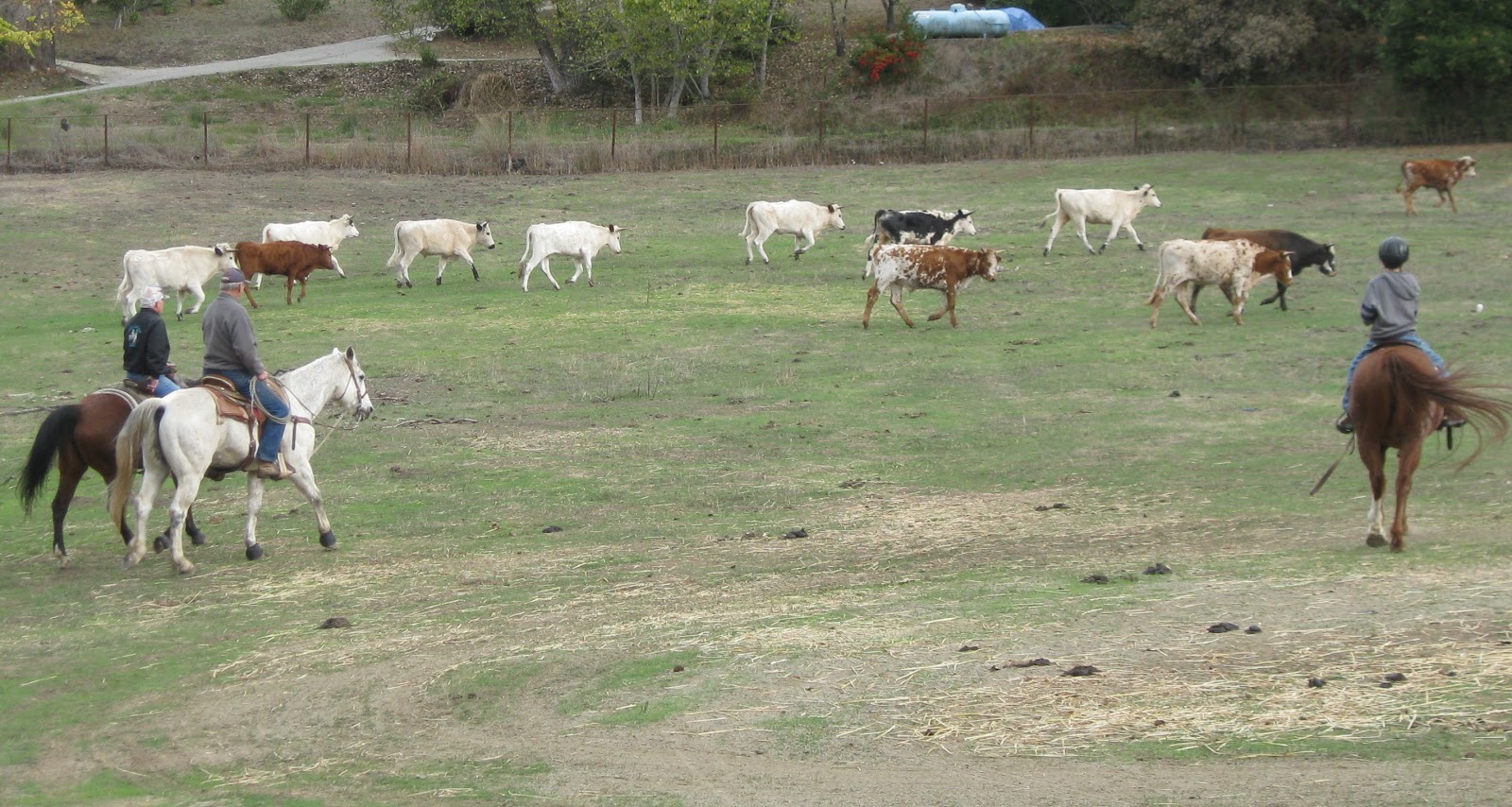


            Then, more loping here and there, and ducking and dodging with the cattle took place, as we worked to get the more recalcitrant critters through the holding pen gate and then through the gate into the alley. Again, much too busy and moving too fast to take photos. Then I had to lope ahead of the group to open the gate that leads to the roping chutes, as someone had (ahem) forgotten to open it previously. So, again, no time to take photos. 
But here’s a shot from this spring showing my son and our friend Wally pushing the herd up the alley toward the roping chutes.


Once the cattle are loaded in the chutes the roping begins. The big fun for my son comes when there is a steer that is deemed no good to rope (lots of reasons—it “sets up” or it “drags” or it turns left in a determined way…etc), and my kid and his trusty steed, Henry, get to chase this animal down the arena.

            Anyway, thinking about gathering cattle reminded me of the many, many times I have done this. First on our family ranch here in Santa Cruz County, then on the northern California commercial cattle ranch where I worked in my 20’s, then in the central valley and the foothills where I worked for various cowhorse/cutting horse trainers (gathering the cattle was always the first chore of the day), and finally here on my uncle’s little ranch in the Santa Cruz Mountains. Almost fifty years of gathering cattle. I guess I should know how to do it by now(!)
            Gathering cattle (and working cattle in general) is all about a sort of intuitive understanding of a cow’s body language. You have to be able to read the cattle. A recalcitrant sort of cow will need you to be far more “in her face” to turn her and get her moving in the right direction. A flighty animal will need you to back off. You have to be able to tell what the cattle are thinking. It’s also important to read the herd as a group. Some people can work with cattle for many years and still they always seem to be in the “wrong place.” Just like people who have horses for many years and never learn to “read” them very well. And the skills that one uses in reading and moving cattle do translate to some degree to reading horses, though the two species have some BIG differences.
            Actually, the skills used in reading cattle or horses also come in handy when herding any sort of critter—including chickens. Trust me, I know.

            (The above photo is Toby, our banty rooster, crowing defiantly at me as I attempt to "herd" the chickens back in the coop after a day out in the garden.)

Anyway of course there are no photos of me cause I am the one holding the camera (as I usually am), so I talked my intrepid companion into taking a shot of me when we went riding the next day. A little blurry, but you get the idea. Sunny and me—having fun covering some country in November.


I know some of you, like me, enjoy working cattle in various disciplines, but maybe for a few of you it’s a new experience. Many of our authors here on the site are involved with dressage. And our readers do everything from endurance to reining. So our riding disciplines are pretty different—does gathering cattle seem exotic to some of you, just as high end dressage seems exotic to me? Anyway, this is what my riding time has looked like lately.
Happy Thanksgiving to all—I am so grateful for my happy life here with my horses and family (not to mention my garden and other critters)—words can’t express it. I hope you all have much to be grateful for, too.
And for those who are already embarked on Xmas shopping (black Friday and all that), I would like to point out that the first two novels in my mystery series featuring equine veterinarian Gail McCarthy are currently on sale as Kindle editions for 99 cents each. For just shy of two dollars you can give a fun Xmas present to anyone who likes horses, mysteries and reading on Kindle. Or you can give them to yourself to enliven the darker days of winter. Here is the link to Cutter, the first book, set against a background of western ranches and cutting horses, and Hoofprints, the second book, which revolves around murder in the world of professional trainers and reined cowhorses. Come take a peak at the western cowhorse world where I have spent my horse time.
Cheers--Laura


PS For those who prefer to read "physical" books, I'm thinking to have a giveaway. If you're interested, leave a comment to let me know. I'm never sure how many folks prefer "real" books to digital.

Wednesday, August 29, 2012

When a Bombproof Horse Has a Meltdown


                                    by Laura Crum

            You all know how I am always bragging about my son’s bombproof horse, Henry? Well, the other day Henry had a meltdown, and it was very instructive. So today I’m going to tell you a few things I learned from this. I can’t say that I didn’t know them already, but I got, shall we say, reminded of them.
            First off, there’s never been a time when I talked about our bombproof trail horses that somebody didn’t chime in about how no horse is bombproof. This is, of course, true. Any horse can get stung by a bee and pitch a fit. Realistically, most any horse is going to react if, say, an actual bomb went off nearby. So that’s a given.
            What I mean by bombproof is a horse that is reliably steady and solid-minded, a horse that faces the unexpected scary thing with a minimum of fuss. A safe horse. And Henry is that. He has carried my son for five years on hundreds of trail rides and gathers and has never hurt or scared my kid. But the other day Henry kind of had a meltdown.
            Ok, a mini-meltdown. Here’s how it went.
            We’d gone out to gather the cattle on a cool, foggy morning. There were four of us. Myself and my son, our young cowboy/ horse trainer friend, Mark, and Bert, an 80 year old cowboy. Bert brought his cow dogs along. The cattle were in the lower field and we had to ride down a steep hill to get there. Just as Henry was on the steepest part of the hill, one of Bert’s dogs burst out of the brush behind the horse and literally ran underneath him. It startled Henry and he jumped forward, at which point his feet slipped in the loose oak leaves that are deep on the ground here and he scrambled a little. I heard my son yell (I was in front) and turned around to see Henry just regaining his balance. Henry didn’t fall, didn’t really come close to it, but both he and my son were obviously a bit rattled. Still, Henry walked off as normal, and we set about gathering the cattle out of the lower field.
            There were some fresh cattle that had been recently added to the herd and the whole group was pretty skittery. Bert’s cowdogs were enthusiastic. Those of you who have done this sort of work will know where this is going. We ended loping here and there to get the cattle boxed in the end of the field, and, eventually, through the gate to the upper field. I wasn’t watching my son, as I was trying to herd skittery cattle and I knew my kid knew where to be. Imagine my surprise as I turned to look back after the last flighty steer ran through the gate. My son was struggling with Henry, who was prancing and dancing sideways against the bridle. Mark looked, too. “Somebody feels good,” he said.
            My kid wasn’t scared; he looked more puzzled. “What is going on with him?” he asked me. “He won’t behave.”
            I was puzzled as well. This was unlike Henry. He appeared jacked up, as if he really wanted to go crashing through the gate after the cattle. He was dancing and prancing sideways with his head in the air and his tail up. My son couldn’t ride him through the very narrow (four foot) gate because of all the sideways prancing.
I told Mark to go ahead with the cattle and parked the fortunately quite calm Sunny next to Henry. “Let’s just sit here a moment and see if Henry calms down,” I said.
But Henry was agitated, bowing up his neck and pawing the ground with impatience. Sunny stood quietly. I tried to exude calm. My son still wasn’t scared, but he WAS anxious.
“What do I do?” he asked. “This isn’t like him.”
“No, its not. Let’s just sit another moment and see if he quiets.”
My son sat quietly on his horse, on as loose a rein as he could, only picking up the reins to correct Henry’s inclination to dance off. Despite his worry about the horse, my kid’s body posture was relaxed, the result of many, many hours in the saddle—hours that have virtually all been happy, confident and enjoyable. His body doesn’t have the pattern of tensing up, even in a bind.
After a minute Henry quit pawing the ground and we were able to walk through the narrow gate successfully, but Henry’s head was high and his eyes were big. He was still prancing a little. I know my son and I were both wondering if this meltdown was going to escalate. Henry is 24 and as solid a citizen as ever lived, but he’s not really a deadhead. There’s still a lot of horse there. (Henry's breeding is all "running" QH--if you looked at his papers you'd think he'd be a pretty hot horse.) I gave some thought to telling my kid to get off and then ponying Henry myself, but decided that as long as we were doing OK, we’d keep working through it. And Henry was listening. He was “up”, but not out of control.
“Ride him up the hill,” I said. “See if he’ll line out.”
My son sent Henry up the hill, and almost immediately the horse’s arched neck relaxed and he lined out in a steady long trot. My son looked back over his shoulder and smiled, and then trotted Henry to catch up to Bert and Mark, who were putting the cattle in the holding pen. I followed, keeping an eye on Henry, but his demeanor seemed to have gone back to normal. He was willing to relax into a flat-footed walk. The meltdown was over.


My son finished getting the cattle in the alley, and Mark gave him a high five for being a good cowboy. My kid’s grin was now a mile wide, and I was glad I hadn’t told him to get off the horse. It’s always a judgment call, but even under the circumstances I trusted Henry.
And this folks, this is what a bombproof horse really is. It’s a horse that, even when he has a meltdown, is still safe. Your eleven year old kid can control him through a temper tantrum. Yes, Henry pranced and danced, and threw his head and skittered sideways. He even pawed the ground. But he held it together (with a little quiet encouragement), and was able to go on and finish the job. I call that a bombproof horse.
I still don’t know what got into Henry. It was a cool morning after a lot of hot days and Henry is fit and sleek—in very good shape. Maybe he just felt good. Or maybe slipping on the hillside rattled him more than I would have guessed. Maybe he was remembering the days when he was a cowboy’s horse and just seriously wanted to take off after the running cattle (though we’ve gathered this field many times and he’s never reacted like this before). Maybe a wasp stung him—it’s the right time of year for that and his sudden jump on the hill and subsequent jacked up behavior is consistent with something like that. The truth is I’ll never know. What I do know is that despite the fact that something lit his fire, he remained controllable enough that my son could ride him.
Of course, Henry’s meltdown could have been aggravated into more of a problem if my son had not reacted so well. There are riders who would have jerked the horse in the face and gotten after him for his “bad” behavior, and this would just have made the problem worse. And there are people whose fear would have caused them to take a death grip on the reins and cling hard with their legs—a recipe for disaster. There are also those who would have been very quick to get off, and this would not have helped things. Though I agree that a rider should get off if he/she feels seriously threatened, in general you shouldn’t be riding a given horse if you feel the need to get off if that horse has a bad day. Getting off solves nothing and only reinforces the negative behavior.
I’m very protective of my son, and if I had seen any sign that he and Henry were not going to be able to work through the meltdown, I would have had him get off, yes. But then I would have got on the horse and made darn sure that the meltdown did not equate in Henry’s mind with getting out of the job at hand. You don’t punish a horse for such behavior—as much as you can you ignore it—and you get on with the job at hand.
In the case of a young horse or a problem horse, where you feel that this isn’t possible, given the horse’s degree of upset, my course of action would have been to tie the horse to the arena fence and let him “soak” while we roped. When the horse had got over his upset enough to think clearly, I’d go back to riding him. That’s how you get them broke to being reliable horses.
In Henry’s case, as he IS a reliable horse, a few moments of standing with a quiet companion in order to collect himself, and then the offer to line out in the long trot was enough to get him back on his steady track. And as a sidelight, do not neglect the power of the long trot as a training tool. In the days when I rode young horses, if I had to tie one up to think things over cause it was having a meltdown, when I felt that horse was calm enough to ride, I would have lined it out in the long trot. Either for a good many laps around the arena, or better yet, up a good long hill. The long trot, if you keep plenty of forward momentum, is the gait of choice for the jacked up horse. It allows him to get his energy out in a positive way, and its harder for a horse to spook, buck or bolt from that gait than either the walk, slow trot or lope. Not that they CAN’T spook, buck and bolt from the long trot—cause they darn sure can. But they are less likely to. Walking feels safer to beginners, but it isn’t. Not on a horse that has a ball of energy he needs to find a release for. And the lope does lend itself to bucking and bolting—as I think we all know.
In any case, Henry proved to me once again that he is a truly bombproof horse—in the sense that any horse can ever be a bombproof horse. Even his meltdown was quite dealable with for my son. And, in fact, it was actually helpful. One more brick in the wall of becoming a good horseman. If our horses never misbehave at all, we never learn the skills for dealing with a misbehaving horse. So thank you Henry, once again. You’ve been a wonderful teacher and guide for my kid—you have a forever home with us. We love you. 

Tuesday, August 24, 2010

The Escape Artist---and a Disaster

by Laura Crum

As some of you know, I ride several days a week at a local arena where my friends practice team roping. I used to be a roper, but gave it up when I got pregnant at 43, and I’ve never taken it back up again, having decided I prefer trail riding. But I do love moving cattle on horseback, and I enjoy being with my friends, and its also nice to lope circles in a big, well groomed arena once in awhile, so my son and I go ride with the ropers a couple of times a week.

Our favorite chore is gathering the cattle. This is not exactly a real big deal, as the cattle are in a twenty acre pasture. But they can be resistant and the pasture has steep hills and a several acre section of redwood forest, so this can make things interesting. Last time we gathered, we had to do a bit of loping to and fro across the field to deter the leaders from making a break and it was all great fun. Then, when the herd was safely in the catch pen, my friend Wally said, “We’re missing one.”

Sure enough. The dark red brindle steer was missing.

This was not good. Those of you who are cow people know that cattle are herd animals, and they seldom leave the herd unless they are sick or injured.

But another friend, Mark, said, “That steer is an escape artist. He probably got out.”

Oh dear. Because on one side of this pasture are some suburban houses and on the other is several hundred acres of unfenced forest land. Neither scenario was a positive one.

Obviously we had to go look for the steer. Some people rode the fenceline. My son and I rode into the section of the pasture that was forested, to see if the steer was hiding out.

Down the hill we went, riding into a dark gully full of redwood trees, with a steep little creekbed at the bottom. I was not on my steady Sunny horse, but on my friend’s six year old blue roan gelding, Smoky. Smoky is a good, level headed young horse, but he is not Sunny. He jigged a bit and fretted, looking anxiously into the bushes as we crossed back and forth through the dark, hilly forest, trying to find a dark red steer. (So, why couldn’t it have been a white steer, ya know?)

My son, on Henry, was his usual fearless self. “I’m right behind you, Mama,” he said as we slogged up yet another hill to the very top corner of the pasture.

I still didn’t see the steer anywhere. But Smoky was focused very intently on the redwood tree at the top of the hill and his whole body was tense. I’m not going to kid you, I took a good grip on the saddle horn, and felt of my horse’s mouth. “What’s up, Smoky,” I said in a meant to be calm voice, hoping quite strongly that he would not spook and try to take off down this steep hill.

“He sees the cow, Mama,” said my son.

“He does? Where? I don’t see him.” And I didn’t.

“He’s lying down. Right behind the redwood tree,” said my sharp eyed kid. “I see him. So does Smoky.”

I urged Smoky to take a step forward and I looked down. Sure enough, right behind the tree, not ten feet from me, lay the dark red steer, holding perfectly still, looking right at me. Well, damn. Its not many cattle that will purposefully leave the herd and then hide from you like that. This was obviously one wily steer.

“Get ready,” I told my kid. “We’re gonna get him up.” And I stepped Smoky toward the steer and slapped my leg with my hand, yelling, “Here now,” or something equally meaningless.

Smoky was tense but willing. He didn’t spook when the steer hopped up under his nose and he didn’t run off when the animal took off down the mountainside. My son and I followed at a more sedate pace and I yelled to let the others know where we were and that we’d found the missing cow.

Some ten minutes later, with several friends helping, the wily red steer was herded into the catch pen to pay his dues as part of the roping herd. And my son had a grin a mile wide.

“We’re good cowboys, aren’t we Mama?” he said. And, I guess, in a manner of speaking, we are. Though I can tell you, I quite sincerely wished I were riding Sunny a few times while we were trekking through that forest.

So that’s my little adventure for today. Does anybody else out there suffer from nerves when their horse gets tense? Man, all a horse has to do is get on the muscle just a little and I tense up inside. I know better than to get tight with my legs or pull on the horse too much, but inwardly I am just as anxious as can be. I can hide it pretty well, but its still there. And this is why I value Sunny so much. He doesn’t get tense—and so I don’t either. But I am riding Smoky a lot, so I need to work on this. Any suggestions?


PS—I wrote this post on Friday. On Sunday my friend and boarder, Wally, took Smoky to a practice roping—I didn’t go. When Wally came home he had a sad story to tell, and both he and I are puzzled and, I will admit, distressed. Because after three years of absolutely no indication that he’d ever do anything violent, Smoky blew up—shortly after being saddled, while tied to the trailer. Bucking and bouncing off the end of the leadrope. Wally untied him, thinking to spare the horse getting hurt on the trailer, and also thinking he could get his attention and get him under control. Not so. The horse was bucking blind, for what reason we don’t know; he acted like a cinchy horse, but this horse has never shown one indication of cinchiness in his entire life. Whatever the reason, he bucked over the tongue of the trailer and got himself hung up in the safety chains. He ended up on the ground, with half his body under the truck and his leg still in the chains. Wally thought he would simply have to find the quickest way to kill him.

The other ropers gathered around and were able to immobilize the horse. They actually had to jack the trailer up to free his leg and drive the truck off the top of him. To Wally’s amazement, Smoky stood up and walked off sound, though with a nasty cut on his pastern. The vet who came said she thought the cut did not go the joint. The next day Smoky was slightly lame and sore, but not excessively so, for what he had been through.

We’re doctoring him, and healing him up, but both Wally and I are really sad. Because if a horse will do this once, for whatever reason, he’s capable of doing it again. I, for one, am not game to ride him any more. At least not until someone else has ridden him for a good long time, and it has been clearly demonstrated that he’s safe. I don’t think Wally should ride him either. Wally is 77 years old. Neither he nor I have any business messing with a horse who is capable of being violent.

But it makes me very, very sad. Because we put a lot of effort into bringing Smoky along and the horse was doing so well. As evidenced by the first part of my post, I trusted him. I never, ever thought that he would be capable of violent, blind bucking. I never saw one sign that he was the least bit prone to being cinchy. I’ve been wrong before, so that’s no surprise, but seldom have I been this blind-sided by a horse.

Anyway, there’s my horse story for today. Any thoughts?