Hi Everybody,
It was fun to be back in New York. It's amazing how different the city looked to me since I moved to the Midwest. I used to drive in every day to work and didn't think much about it, but now that I live out in a suburb with lots of open spaces, the city seemed totally different. Fun, exciting, with lots to do but I found myself missing the openness of my new home at the same time. Or perhaps I was missing the three little voices calling "Mom."
The Backspace Conference Agent Author Day was enormously helpful to me as a writer and I would heartily recommend it to anyone considering a career as an author. I received feedback on my query letter and on my first five pages. Interestingly, some of the feedback on the opening pages ran counter to some advice I'd received previously from another respected agent, which I think illustrates an important point. The judgment of any one agent or editor are subjective. Personal taste plays a large role in each agent's decisions on what to represent. As different people read their work aloud, more than once I heard "It's good, it's just not my cup of tea" from the participating agents. This brought home to me the importance of thoroughly researching any agent I want to query. I read their submission guidelines on multiple sites and read the books of authors they represent.
The agents are consistent on quality of writing, and I know that for any agent I need to polish my work until it gleams. They all want to see excellent writing in the pages submitted, but where I found more difference of opinion was in the particulars they like to see in query letters. Many agents participate in online workshops and/or have blogs, so I would recommend looking through these. Many of them will post query letters they received that they particularly liked.
Anyway, here's what they had to say about mine:
Query letter:
They liked the general format of it. Mostly it needed to be tightened up. I needed to write less in my paragraph describing the work, leave out the secondary character Fiona, and focus more on the romantic relationship between my protagonist, Gemma, and Connor Hogan. They liked the idea of a romantic relationship where one partner can influence the perceptions of the other. Does call for the ultimate bit of trust, don't you think?
As to the opening pages, they recommended less stylized language. In other words, fewer complicated clauses. Keep the writing simple and straightfoward.
So now I have a query letter to rewrite, opening pages to simplify and a manuscript to finish. On the bright side, one agent in particular loved the concept so she'll be on the top of my list of agents to query!
Cheers,
Mary
Showing posts with label query letter. Show all posts
Showing posts with label query letter. Show all posts
Friday, June 5, 2009

Thursday, May 21, 2009
Query Letter Connection
Hi Everybody,
As promised in my last post, I have some information to share from last year's Backspace Writer's Conference on writing query letters. Since I am focused on fiction, these notes are specific to fiction queries. There are a couple of general items that apparently happen quite frequently. One is that the query letter is titled Dear Sir/Madam or some other generic format. Agents prefer to be addressed individually and although it's fine to query more than one agent at an agency, it is best to query only one at a time.
The second point is to research the agents preferences for submissions. Their preferences vary. Some want only the query letter, others prefer to also have a certain number of pages of manuscript as well. Most agents now accept email submissions and some only email submissions but it's always good to check. I always start with the agency's web site for genres they represent and and then also There are some great sites to gain information about agents and the types of work they represent. These sites often also include submission requirements. I always check The Association of Author Representatives at http://www.aaronline.org/mc/page.do as well as Publisher's Marketplace at http://www.publishersmarketplace.com/.
Often, if you write in a particular genre there will be an organization of writers in that specialty which will include lists of agents. For example, Romance Writers of America has a list of agents representing romance.
The agents who spoke at last year's conference varied to a degree in what catches their eye in a query letter, but there were a some general themes that stood out. First, state up front what your genre and word count is. Then, succintly describe the novel. Here is where your writing style needs to shine. I've heard people say this section of the letter should sound similar to back cover copy. It needs to catch the agent with not only the content, but the strength of the writing. They also often said no 'What would happen if' statements and if there's humor in the book, reflect it in the summary.
It is helpful to include a brief statement about your previous experience as a writer if it is applicable. For example, I included the titles of my two novels but not specifics about the medical writing I have done beyond a brief statement I have expertise in that area. If you have expertise in the area about which you are writing, this is great to add. For example, horse people writing equestrian fiction write compelling narrative because they've lived it.
Well, folks, I'll be flying to New York next week to sit in front of between 12 and 18 agents. I'll post their comments on the query letter when we get back. They say to be prepared for open, honest feedback. Okay, here I go...
Cheers,
Mary
As promised in my last post, I have some information to share from last year's Backspace Writer's Conference on writing query letters. Since I am focused on fiction, these notes are specific to fiction queries. There are a couple of general items that apparently happen quite frequently. One is that the query letter is titled Dear Sir/Madam or some other generic format. Agents prefer to be addressed individually and although it's fine to query more than one agent at an agency, it is best to query only one at a time.
The second point is to research the agents preferences for submissions. Their preferences vary. Some want only the query letter, others prefer to also have a certain number of pages of manuscript as well. Most agents now accept email submissions and some only email submissions but it's always good to check. I always start with the agency's web site for genres they represent and and then also There are some great sites to gain information about agents and the types of work they represent. These sites often also include submission requirements. I always check The Association of Author Representatives at http://www.aaronline.org/mc/page.do as well as Publisher's Marketplace at http://www.publishersmarketplace.com/.
Often, if you write in a particular genre there will be an organization of writers in that specialty which will include lists of agents. For example, Romance Writers of America has a list of agents representing romance.
The agents who spoke at last year's conference varied to a degree in what catches their eye in a query letter, but there were a some general themes that stood out. First, state up front what your genre and word count is. Then, succintly describe the novel. Here is where your writing style needs to shine. I've heard people say this section of the letter should sound similar to back cover copy. It needs to catch the agent with not only the content, but the strength of the writing. They also often said no 'What would happen if' statements and if there's humor in the book, reflect it in the summary.
It is helpful to include a brief statement about your previous experience as a writer if it is applicable. For example, I included the titles of my two novels but not specifics about the medical writing I have done beyond a brief statement I have expertise in that area. If you have expertise in the area about which you are writing, this is great to add. For example, horse people writing equestrian fiction write compelling narrative because they've lived it.
Well, folks, I'll be flying to New York next week to sit in front of between 12 and 18 agents. I'll post their comments on the query letter when we get back. They say to be prepared for open, honest feedback. Okay, here I go...
Cheers,
Mary
Thursday, February 26, 2009
The Art of Hanging In There
Hi Everyone!
I've been so impressed with the interesting, informative posts by my fellow Equestrian Ink authors on the process of getting published. I thought I would share the circumstances under which I worked up my courage to send in my query letters for A Dangerous Dream.
As some of you may know, I wrote my first novel, A Dangerous Dream, while I was on bedrest with a twin pregnancy. I had never written fiction in my life but had always dreamed of doing so. My poor husband had lost track of which novels he'd already bought me among the stacks piling up in my bedroom, so in desperation I started making up my own stories while I lay there with the approximate mobility of a beached whale.
In between cravings for ice cream and lobster (my husband got major kudos from my family and friends for the amount of take-out lobster dinners he served me in bed), I started pecking away on a laptop (which was a considerable balancing act seeing as I had no lap). Before long my page count started growing even faster than my belly, which is really saying something.
Needless to say, when the obstetrician said we aren't going to hold off the grand entrance of the twins any longer and I delivered my two amazing boys, the nearly completed novel went on the back burner. It was a rude awakening (no pun intended) to realize that our newborn twins were not in sync on night time awakenings. Despite all attenpts to try for 12:30 and 4 AM, night feedings often were more like 11, 1, 3, and 5 AM. A few months later, when my brain was approaching the consistency of oatmeal, a friend suggested I join a group of some kind which was unrelated to my mommy job.
I was so involved with the kids the thought of doing something for myself seemed completely alien. The only other interest nagging at the back of my mind was the novel I had written. I joined Romance Writers of America and with absolutely no idea what I was doing sent off a couple of query letters to agents and got polite rejection letters.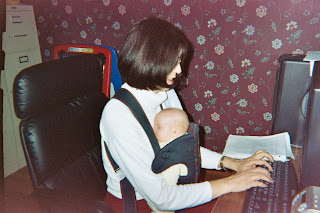
My husband, bless his heart, encouraged me to keep going on writing so I went to an RWA meeting and was told about an organization called PRO for writers who completed a novel but hadn't sold one yet. She told me I needed a rejection letter from a publisher to join so I figured that would be easy enough to come by. In my sleep deprived state it didn't occur to me my two agent rejection letters would have sufficed, so onward I trudged looking for a publisher to send my book and get a rejection letter for a PRO application.
I learned that the turnaround on queries was generally fairly quick with epublishers so I quickly wrote out a query letter and sent it off to two epubs members of my local RWA chapter had published with and found to be reputable. About two months later, when my boys sleep schedule was finally stretching out, I was up early checking email and I saw an email from one of the epubs I'd queried. The subject line said contract so I took a sip of my coffee, blinked a few times, and tried reading it again. It still said Contract so I took a deep breath and opened it.
There it was. In place of the expected rejection was a contract offer. I jumped up and realized that for the first time in a long time the whole family was asleep. Drat! I looked at my heroic husband and didn't have the heart to wake him so I had to wait for the boys next call for food. My daughter, by the way, learned to sleep through just about anything. It didn't hurt that her baby brothers had her wrapped around their little fingers.
When Eric awoke and repeated my blinking re-read of the email we had a decision to make. We had never dreamed of having the opportunity to publish so soon and I was very concerned that the book could be made much better with more time and attention. Eric came up with the point that finally decided us. He reminded me that most authors wind up putting their 'learning book' in a drawer. Here was an opportunity for us to keep learning from it.
And learn we did. I had the opportunity to learn web design, online chats, an array of marketing and promotional venues, and the all important review process. Best of all, I got wonderful feedback from readers and the opportunity to be a part of Equestrian Ink. The epublishing market did not bring in revenue as a traditional publisher would have, but the learning experience was invaluable.
I suppose my story is that great things can come when you least expect it. I thought our miracles were complete with our beatiful, health three children, but we got a bonus. A second career and here's the best part - my husband is working with me on my current novel. It's a contemporary fantasy where the structure and function of an international society of witches mirrors that of the real life intelligence community. My husband was the TA in graduate school for a course titled Intelligence and Covert Operations. He never guessed he'd be using that background to help his wife write a novel!
The paths to publication are many and varied but never give up. Your own miracle might be just around the corner!
Cheers,
Mary
I've been so impressed with the interesting, informative posts by my fellow Equestrian Ink authors on the process of getting published. I thought I would share the circumstances under which I worked up my courage to send in my query letters for A Dangerous Dream.
As some of you may know, I wrote my first novel, A Dangerous Dream, while I was on bedrest with a twin pregnancy. I had never written fiction in my life but had always dreamed of doing so. My poor husband had lost track of which novels he'd already bought me among the stacks piling up in my bedroom, so in desperation I started making up my own stories while I lay there with the approximate mobility of a beached whale.
In between cravings for ice cream and lobster (my husband got major kudos from my family and friends for the amount of take-out lobster dinners he served me in bed), I started pecking away on a laptop (which was a considerable balancing act seeing as I had no lap). Before long my page count started growing even faster than my belly, which is really saying something.
Needless to say, when the obstetrician said we aren't going to hold off the grand entrance of the twins any longer and I delivered my two amazing boys, the nearly completed novel went on the back burner. It was a rude awakening (no pun intended) to realize that our newborn twins were not in sync on night time awakenings. Despite all attenpts to try for 12:30 and 4 AM, night feedings often were more like 11, 1, 3, and 5 AM. A few months later, when my brain was approaching the consistency of oatmeal, a friend suggested I join a group of some kind which was unrelated to my mommy job.
I was so involved with the kids the thought of doing something for myself seemed completely alien. The only other interest nagging at the back of my mind was the novel I had written. I joined Romance Writers of America and with absolutely no idea what I was doing sent off a couple of query letters to agents and got polite rejection letters.

My husband, bless his heart, encouraged me to keep going on writing so I went to an RWA meeting and was told about an organization called PRO for writers who completed a novel but hadn't sold one yet. She told me I needed a rejection letter from a publisher to join so I figured that would be easy enough to come by. In my sleep deprived state it didn't occur to me my two agent rejection letters would have sufficed, so onward I trudged looking for a publisher to send my book and get a rejection letter for a PRO application.
I learned that the turnaround on queries was generally fairly quick with epublishers so I quickly wrote out a query letter and sent it off to two epubs members of my local RWA chapter had published with and found to be reputable. About two months later, when my boys sleep schedule was finally stretching out, I was up early checking email and I saw an email from one of the epubs I'd queried. The subject line said contract so I took a sip of my coffee, blinked a few times, and tried reading it again. It still said Contract so I took a deep breath and opened it.
There it was. In place of the expected rejection was a contract offer. I jumped up and realized that for the first time in a long time the whole family was asleep. Drat! I looked at my heroic husband and didn't have the heart to wake him so I had to wait for the boys next call for food. My daughter, by the way, learned to sleep through just about anything. It didn't hurt that her baby brothers had her wrapped around their little fingers.

When Eric awoke and repeated my blinking re-read of the email we had a decision to make. We had never dreamed of having the opportunity to publish so soon and I was very concerned that the book could be made much better with more time and attention. Eric came up with the point that finally decided us. He reminded me that most authors wind up putting their 'learning book' in a drawer. Here was an opportunity for us to keep learning from it.
And learn we did. I had the opportunity to learn web design, online chats, an array of marketing and promotional venues, and the all important review process. Best of all, I got wonderful feedback from readers and the opportunity to be a part of Equestrian Ink. The epublishing market did not bring in revenue as a traditional publisher would have, but the learning experience was invaluable.
I suppose my story is that great things can come when you least expect it. I thought our miracles were complete with our beatiful, health three children, but we got a bonus. A second career and here's the best part - my husband is working with me on my current novel. It's a contemporary fantasy where the structure and function of an international society of witches mirrors that of the real life intelligence community. My husband was the TA in graduate school for a course titled Intelligence and Covert Operations. He never guessed he'd be using that background to help his wife write a novel!
The paths to publication are many and varied but never give up. Your own miracle might be just around the corner!
Cheers,
Mary
Tuesday, February 10, 2009
The Road to Publication con't. . . .
by Kit Ehrman
During my “Road to Publication” post on January 27th, I mentioned that I’d provide some specific pointers and ask some hard questions for those looking to get published.
What follows is a list I compiled and saved in an email draft because I receive so many queries from writers who want advice on how they can break in. One question (complaint, really) that I hear time and again is: “How can an agent or editor make a decision about my work based solely on a one-page query letter? They won’t know how well I can write unless they read the whole manuscript?”
Believe me; I understand this sentiment and sympathize with the writer’s frustration, but once you look at the other side of the equation—what it’s like to be the gatekeeper—you can see the validity of the “query only” limitation that is often part of the submission process.
A query letter serves the purpose of letting the agent or agent’s reader know if the project is something they’re interested in pursuing; therefore, it has to be extremely well written.
Editors and agents are swamped with submissions so, imagine if you will, the office receiving 200+ manuscripts a week instead of 200+ query letters. Query letters are a necessary evil of the publishing business because the competition is so fierce.
There are many things every writer can and should do to improve her odds. Ask yourself:
Editing
• Have you edited the manuscript many, many times?
• Have you studied the rules of grammar? (You need to understand them before you can break them for effect.)
• Have you learned the industry’s conventions such as proper manuscript format?
• Has your manuscript been through an objective critique group?
• Have you hired a professional freelance editor to give you input? (Get references if you go this route.)
• Have you had a lot of readers, who are familiar with the genre you’re writing in, read the manuscript and give you feedback?
• Is the manuscript as perfect as you can possibly make it?

The Query Letter
• Have you attempted to get writing credits to include in your query letter by entering contests or publishing short stories in genre-specific magazines?
• Have you studied what should go in a query letter?
• Have you polished your query letter ruthlessly?
• Have you shared different versions of your query letter with your critique group to see which one is most effective?
• Have you studied books on querying agents? (The Sell Your Novel Toolkit by Lyons is a good one. So is a book by Kathryn Sands about making the perfect pitch.)

Selecting An Agent
• Have you researched possible agents carefully?
• Do you know how to select the right agent for you?
• Have you looked through the acknowledgements pages of books similar to yours so you can determine agents who like the kind of thing your write? Oftentimes, an author will thank his or her agent in the acknowledgements.
• Have you gone to writing conferences where you can verbally pitch your book to agents?
• Check out a website called Predators and Editors that lists agents to avoid.
Acting Professional
• Have you joined the organizations relevant to the genre you’re writing in so you can become familiar with the publishing industry?
• Have you attended conferences in order to network with other writers, authors, and industry professionals?
I highly recommend that you go to Miss Snark’s website. She’s a New York literary agent. This site is no longer active, but there’s a wealth of information here. Beginning with this link, you can see how she evaluates the hook in a query. What gets her interest, etc. This is very insightful for seeing what works and what doesn’t. Here’s the link where the hook evaluation begins: http://misssnark.blogspot.com/2006_12_10_archive.html. Also, search this website because you’ll find a lot of useful information about the industry in general.
It takes talent, luck, and perseverance to get published. The best way to deal with the query process is to start on the next book while you’re doing it so you don’t become obsessed or depressed by the process. And you’ll be glad you have another book that’s partly done when you do get published, because once you are, you’ll have to promote the first book while you’re writing the second.
Good luck!
Kit Ehrman
www.kitehrman.com
During my “Road to Publication” post on January 27th, I mentioned that I’d provide some specific pointers and ask some hard questions for those looking to get published.
What follows is a list I compiled and saved in an email draft because I receive so many queries from writers who want advice on how they can break in. One question (complaint, really) that I hear time and again is: “How can an agent or editor make a decision about my work based solely on a one-page query letter? They won’t know how well I can write unless they read the whole manuscript?”
Believe me; I understand this sentiment and sympathize with the writer’s frustration, but once you look at the other side of the equation—what it’s like to be the gatekeeper—you can see the validity of the “query only” limitation that is often part of the submission process.
A query letter serves the purpose of letting the agent or agent’s reader know if the project is something they’re interested in pursuing; therefore, it has to be extremely well written.
Editors and agents are swamped with submissions so, imagine if you will, the office receiving 200+ manuscripts a week instead of 200+ query letters. Query letters are a necessary evil of the publishing business because the competition is so fierce.
There are many things every writer can and should do to improve her odds. Ask yourself:
Editing
• Have you edited the manuscript many, many times?
• Have you studied the rules of grammar? (You need to understand them before you can break them for effect.)
• Have you learned the industry’s conventions such as proper manuscript format?
• Has your manuscript been through an objective critique group?
• Have you hired a professional freelance editor to give you input? (Get references if you go this route.)
• Have you had a lot of readers, who are familiar with the genre you’re writing in, read the manuscript and give you feedback?
• Is the manuscript as perfect as you can possibly make it?

The Query Letter
• Have you attempted to get writing credits to include in your query letter by entering contests or publishing short stories in genre-specific magazines?
• Have you studied what should go in a query letter?
• Have you polished your query letter ruthlessly?
• Have you shared different versions of your query letter with your critique group to see which one is most effective?
• Have you studied books on querying agents? (The Sell Your Novel Toolkit by Lyons is a good one. So is a book by Kathryn Sands about making the perfect pitch.)

Selecting An Agent
• Have you researched possible agents carefully?
• Do you know how to select the right agent for you?
• Have you looked through the acknowledgements pages of books similar to yours so you can determine agents who like the kind of thing your write? Oftentimes, an author will thank his or her agent in the acknowledgements.
• Have you gone to writing conferences where you can verbally pitch your book to agents?
• Check out a website called Predators and Editors that lists agents to avoid.
Acting Professional
• Have you joined the organizations relevant to the genre you’re writing in so you can become familiar with the publishing industry?
• Have you attended conferences in order to network with other writers, authors, and industry professionals?
I highly recommend that you go to Miss Snark’s website. She’s a New York literary agent. This site is no longer active, but there’s a wealth of information here. Beginning with this link, you can see how she evaluates the hook in a query. What gets her interest, etc. This is very insightful for seeing what works and what doesn’t. Here’s the link where the hook evaluation begins: http://misssnark.blogspot.com/2006_12_10_archive.html. Also, search this website because you’ll find a lot of useful information about the industry in general.
It takes talent, luck, and perseverance to get published. The best way to deal with the query process is to start on the next book while you’re doing it so you don’t become obsessed or depressed by the process. And you’ll be glad you have another book that’s partly done when you do get published, because once you are, you’ll have to promote the first book while you’re writing the second.
Good luck!
Kit Ehrman
www.kitehrman.com
Subscribe to:
Posts (Atom)